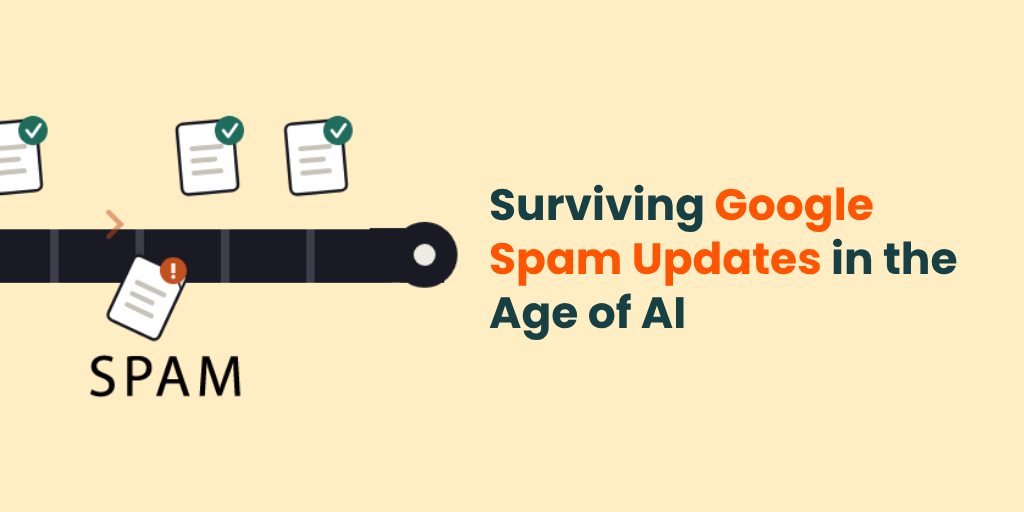
It’s been a volatile year for Organic Search. Between new AI Search tactics, platforms, and constant model/algorithm updates, it’s impossible for the average marketing pro to keep up. Adding even more uncertainty to the equation, Google has rolled out three spam updates in 2026 (March, June, and August) with the last coming barely two months apart. This is a lot of spam-specific updates in less than a year, all aimed at combating the deluge of AI-generated content being published.
Most of these updates won’t affect typical sites avoiding grey- or black-hat SEO techniques. But, one policy worth paying attention to is scaled content abuse, which are pages “generated for the primary purpose of manipulating search rankings and not helping users,” according to Google’s own spam policy guidelines. Neil Patel put it more bluntly in his recent breakdown of the algorithm: “Spam enforcement has intensified, with Google actively targeting manipulative link profiles, scaled AI-generated content, cloaking, and site reputation abuse”.
This specific part of the spam policy is clearly aimed at removing or severely limiting the ranking potential of content that is mass-produced by AI. This raises valid concerns that existing content that is highly templatized and educational can get penalized (or have its ranking potential cut down) even if it was not produced by AI at all. Additionally, tools like AirOps and off-the-shelf AI writers that make it easy to produce fifty blog posts or a hundred glossary entries in a weekend are a very tempting tactic to most marketers. However, delegating this work away from an SEO/GEO content expert can get these pages removed from the index or your entire site penalized if it goes wrong. Google’s own documentation is blunt about what happens next: recovery can take months, because its automated systems need that long to confirm a site is actually following the rules.
Having survived (and thrived) despite these latest Google Spam Updates, we have some important tips on how to balance high output with content quality that avoids being considered spammy.
What Is a Google Spam Update?
A spam update is a separate, and specific algorithm update that changes how Google detects, determines, and acts upon spammy web content.
A core update reshuffles rankings based on relevance and quality whereas a spam update goes after things Google has explicitly banned: cloaking, manipulated links, expired-domain abuse, and scaled content abuse (the one most content teams need to know). If your traffic drops right after one of these rolls out, check whether any part of your site fits that description before you assume it’s just a core update.
How to Avoid Your Content Being Flagged as Scaled Content Abuse
So how do we generate content at scale for SEO and GEO that both adheres to Google’s spam policy and scales to meet growth KPIs? Most importantly, by creating unique content that is genuinely useful to your target audience, that follows Google’s age-old EEAT guidance (Experience, Expertise, Authoritativeness, Trustworthiness). For scaling up, utilizing AI can speed up the drafting and editing process, but at this point we all know that relying upon that too heavily not only results in bad (sometimes sloppy) content, but can actually do more harm to both your brand reputation and organic search results.
Given all the changes in the search industry these past years, a clear winning strategy has emerged:
leverage AI to craft content at a slightly higher rate than the pre-AI era, built around the keywords and questions real buyers actually search. Judge the performance of that content by how much engagement and conversions (leads) it contributes to and less to how much organic visibility it creates. Fewer but better organic sessions is the name of the game.
Google has always denied that dwell time is a ranking factor, and technically that’s true. But the DOJ antitrust trial revealed that Google’s Navboost system does use click and interaction data (including whether someone sticks around or bounces straight back to the results page) to re-rank what it shows. AI Overviews and AI Mode run on the same logic since they pull from pages that actually answer the question clearly and in-depth.
This doesn’t mean smaller companies should stop building educational content. A startup entering a new category still needs a glossary or a set of content anchors to stake its claim and seed both the traditional algorithms and LLMs with topical expertise.
Specific SEO and GEO Content Tactics to Avoid Being Spammy
- Vary the format: Even similar topics shouldn’t all share the same structure, length, and template. Sameness at scale is exactly the pattern spam detection is built to catch.
- Put a real author on it: A named writer with a bio and a track record is basic author provenance, and it’s one of the clearest signals that a page isn’t part of a content farm.
- Have a person actually edit it: AI can outline, and draft but it shouldn’t be the only thing that touches a page before it goes live.
- Spread out publication: Twenty pages over two months reads differently to Google than twenty pages in a weekend.
- Use dedicated skill files or agents per content type: A glossary entry and a comparison page shouldn’t come out of the same generic prompt. Create custom skill files that excel at understanding and producing different content types.
- Syndicate with purpose: Get your content in as many relevant places as possible (both paid and earned), so that LLMs see an obvious pattern to help determine what is actually authoritative content for citation.
- Amplify to the audience that actually cares: Sharing new content with the right community or account is what turns into real reads and real engagement signals that Google loves to see.
- Retire zombie content. Old pages with no traffic, no links, and no reason to still exist are the easiest thing on a site to mistake for scaled content abuse. 301 redirect these to newer and better content on your site.
None of this is about avoiding AI tools. It’s about not letting them run unsupervised at a volume that starts to look, to Google, exactly like the thing it just spent the summer cracking down on.
Scaling your Organic Search Presence the Right Way
The brands coming out ahead in this period of rapid change in the search world aren’t the ones offloading their entire content strategy to AI, but they are also not the ones relying entirely on humans to create. The brands winning in search today are the ones with real expertise, real editorial judgment, and a real SEO/GEO content strategy behind every page and every placement.
That’s the program we build. Firebrand pairs senior SEO/GEO content strategists with a PR team that knows how to earn the coverage that makes your content authoritative in the first place, so your visibility compounds instead of catching a penalty. If you’d rather have experts handle the scale, the risk, and the strategy, get in touch with Firebrand and let’s build a program that is the opposite of spammy.
About the Author

Alastair Nee is Senior Vice President of Digital Marketing at Firebrand, a B2B tech marketing agency based in the San Francisco Bay Area that helps companies grow through creative, data-driven marketing strategy. With a rare left-brain/right-brain approach, Alastair blends sharp analytics with standout creative instincts to build and scale high-performing growth marketing programs that elevate brand profiles and increases their pipeline using the channels and tactics that work best for B2B tech marketing today: GEO/SEO, AI-enhanced paid media, and advanced analytics.
At Firebrand, Alastair leads a team that partners with some of the most innovative names in tech - from AI/ML and data infrastructure to developer tools and B2B SaaS. Over his 17-year career in tech marketing, he has helped launch and grow dozens of companies, delivering award-winning campaigns recognized by The Communicator Awards and other industry benchmarks.
Alastair is a vocal advocate for modern growth marketing and emerging disciplines like AI-powered marketing technology, AI paid media optimization, and Generative Engine Optimization (GEO). His work lives at the intersection of storytelling and performance - where brand meets demand.
Follow Alastair on LinkedIn or explore his thinking on Firebrand’s blog.