At some point soon, if it hasn’t happened already, an exec or board member is going to ask: how are we doing in AI search? It’s a reasonable question with a surprisingly hard answer, unless you have the right tool.
The rise of AI search has quietly handed PR a new job. Getting your brand mentioned still matters, but citations are what actually move the needle. AI models don’t just register that your brand exists, they pull specific sources into responses, attribute claims to URLs, and build answers from content they’ve decided to trust. A mention in a publication that never gets cited does less work than it used to. A citation from the right domain, on the right topic, in front of the right AI model, is now a core part of how you get found. We wrote about this shift in depth in our GEO post from February, if you want the full picture.
We’ve spent time evaluating the tools available for tracking and improving this — and Scrunch is the one we keep coming back to. Better pricing than the field of alternatives, stronger capabilities, a cleaner interface, and support that actually responds. Not a client, not sponsored — just the tool that won when we put them side by side.
This post walks through how to specifically use Scrunch’s AI citation report (Scrunch also reports on AI mentions and much more) across three levels of detail, each one unlocking a different set of insights and a different layer of strategy. At the broadest level, you’re identifying which domains AI models trust most in your category and what that means for where you show up. Go deeper and you’re looking at the exact URLs driving citations, including where competitors are winning and why. Deeper still, you’re filtering by topic to align your PR, influencer, and paid media plays with the specific subject areas where citations are up for grabs. The goal at every level is the same: more citations for your brand, from the sources AI models are already listening to.
AI Citations Report Level 1: Discover Highly Cited Domains
Start with the AI Citations analysis tool/report in Scrunch and filter by “Non-branded prompts” AND “Citation Owner: Third-Party.” What comes back is a ranked list of the domains AI models are pulling from most often when they answer your synthetic prompts. It’s important to note that third-party sources dominate citations across virtually every industry, which means the places where your content lives matters as much as the content itself.
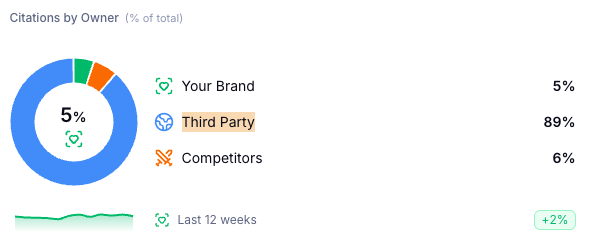
Scrunch – AI Citations summary showing the dominance of third-party sources for earning citations
The resulting domain list tells you where to put your energy. Reddit near the top? Communities on that platform are actively shaping how AI models respond to questions in your category. LinkedIn and Medium in the mix point to exec thought leadership and content syndication as AI models index those posts, and they show up. YouTube getting cited a lot indicates the need for more highly-optimized videos on that platform to support your key topic areas.
An industry-specific domain like securityboulevard.com is a different signal: there’s a publication with real citation weight in your space, and you should probably be in it, whether through a guest post, a contributed piece, or a paid placement. Pay extra attention to the domains where your brand is not mentioned and competitors are, which shows you are losing out on valuable mindshare from those sources.
From there you can get more specific. Filter by topic to see which domains get cited most around a particular subject. Add a persona filter to understand where the sources behind your buyers’ questions are actually coming from. Cut by AI model if you want to know whether Perplexity and ChatGPT are drawing from the same pool as often they aren’t.
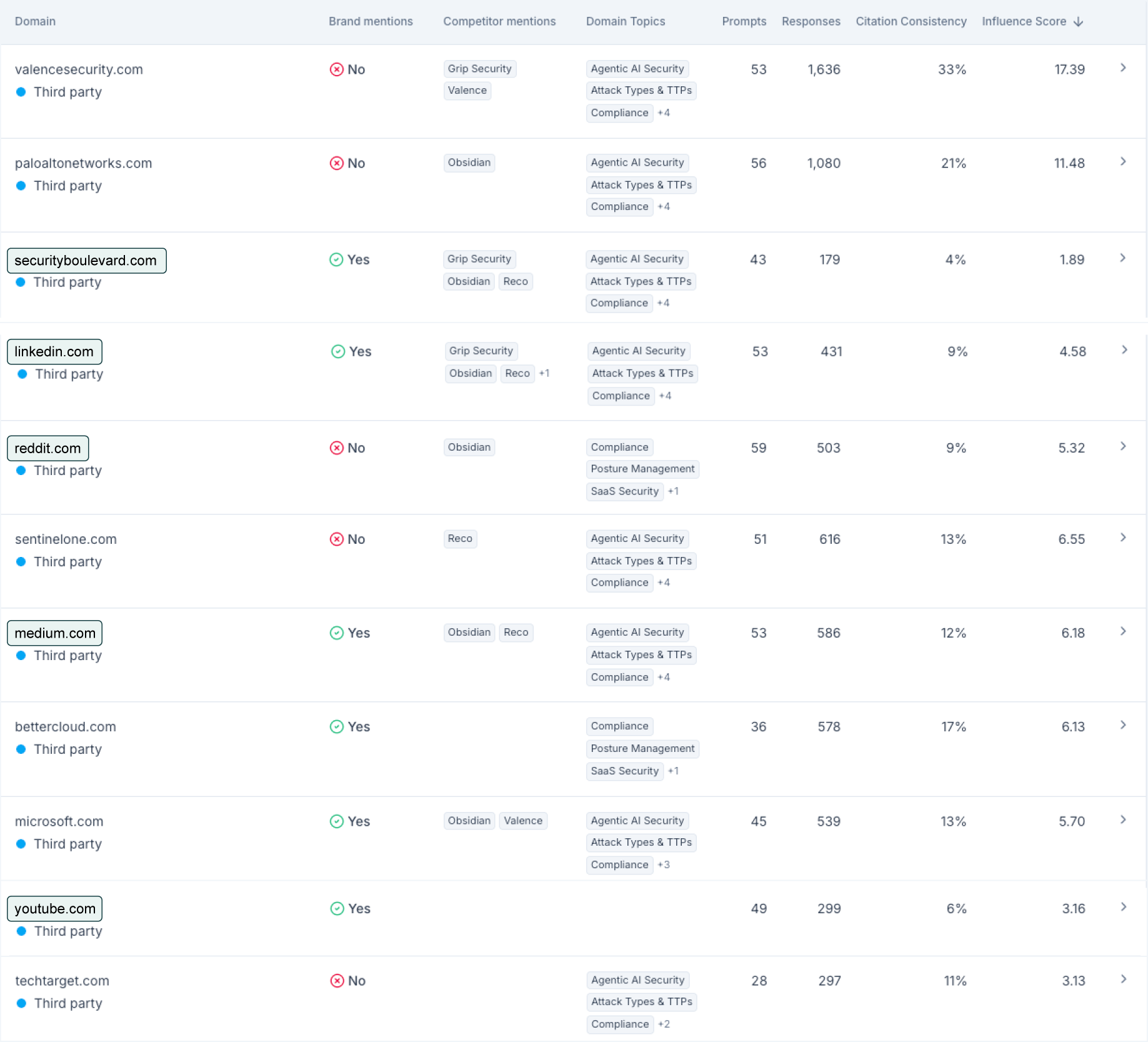
Scrunch – AI Citations Tool showing domains that are winning high citation consistency
AI Citations Report Level 2: Dig Into Cited URLs
Once you know which domains are getting cited, the next move is clicking into them.
Take LinkedIn as an example. Select it in the AI Citations report and you get the actual URLs being cited (specific posts, articles, individual pieces of content) along with whether your brand appears in that citation source, whether a competitor does, and how well each URL maps to your key topic areas. That last column matters more than it looks. High topic alignment plus high citation frequency is a signal worth paying attention to.
In the Scrunch AI Citation Report, you can flip the Citation Owner filter from Third-Party to Competitor. Now, instead of seeing where the broader web is getting cited, you’re seeing exactly which URLs are driving citations for your competition. A competitor’s blog post showing up repeatedly across your synthetic prompts tells you something: the AI models have decided that piece of content is credible and relevant. That’s useful information for your content strategy.
What you do with a specific URL depends on what it is. A blog post or media article you can analyze and outdo by crafting something more current, more detailed, or more specifically tailored to the exact question being asked. A LinkedIn post with high citation consistency tells you the format, angle, or author type that’s getting traction on that platform. In some cases, especially with third-party articles that already mention competitors, there’s a more direct play: contact the author or site owner and ask them to update the piece to include your brand. It’s more common than people think, and it works.
The example below shows how to identify an emerging content type that is winning citations by noticing that a client competitor (Reco.ai) had a high citation consistency on this URL that also mentioned our client’s brand (https://www.reco.ai/compare/saas-security-tools). While the mention is nice, we realized they are creating a listicle to earn mentions and that we should too, which unlocks the ability to be cited not only for key topics (keywords) but also for competitor brand names when prospects are comparing.
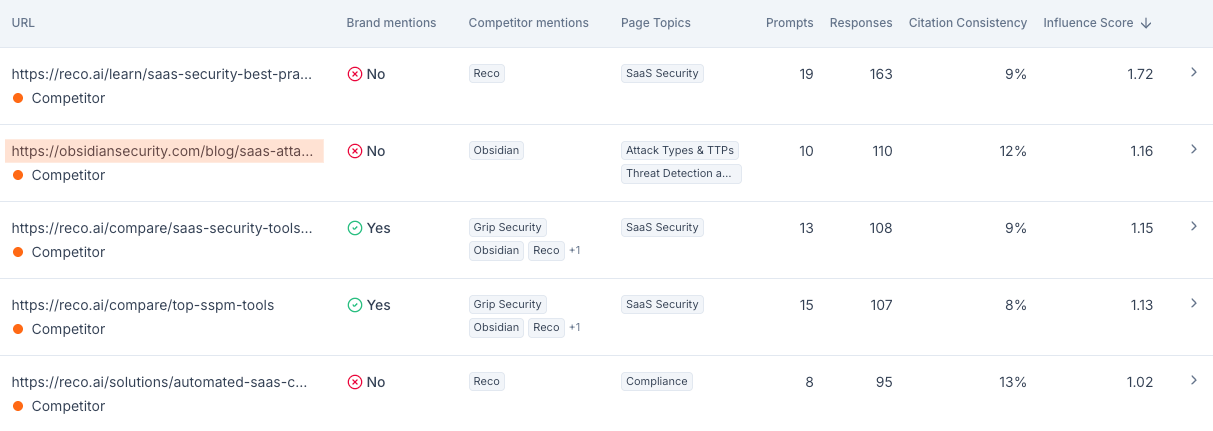
Scrunch – AI Citations Tool showing competitor URLs winning AI citations
AI Citations Report Level 3: Identify High-Value Citation Sources by Key Topic Area Across Influencer and Earned Media
Domain-level data tells you where to show up. Add a Prompt Topic filter and it tells you who to bring with you.
In the Citations report with Citation Owner set to Third-Party, layer in a filter for Prompt Topic (a specific key topic area for a set of your synthetic prompts that perhaps the business is focused on this quarter) and the domain list reshapes around that subject. The sites getting cited most for, say, Attack Types and TTPs are different from the ones dominating citations around Zero Trust or Cloud Security Posture. That distinction matters because the right tactic, and the right internal SME to execute it, changes depending on the topic.
There are three ways to use this view:
- Influencer and community plays: The URLs cited under a specific topic often lead directly to the people and places worth engaging.
- A Medium post on API abuse showing up consistently in your AI citation tool data isn’t just a content signal, it’s a byline. That author has earned enough trust with AI models to be worth a collaboration, a guest post swap, or at minimum a relationship.
- The same logic applies to Reddit threads with real engagement in the right subreddits. A thread about Google Cloud security best practices that keeps getting pulled into AI responses is a place your company’s security architect could contribute naturally, answer a question, add context, mention your brand where it genuinely fits. The AI citation tracking tool is essentially doing the influencer research for you.
- Paid placements: Topic-filtered citation data tells you which publications AI models consistently trust on a given subject which makes them worth paying to be in, two different ways.
- The first is paying to publish. Sponsored content, contributed articles, and advertorials on a highly-cited domain get your brand and your SME’s voice directly into a source that AI search citation tracking tools already show is being pulled into responses. You’re not guessing at domain authority, you have the citation data to back the decision.
- The second is paid advertising on those same properties. Display ads, newsletter sponsorships, content recommendations, these don’t put you inside the cited article, but they put your brand in front of the humans reading the content AI is already citing. That’s a meaningful audience: people actively consuming the sources that are shaping AI responses in your category.
Both plays are stronger when you know which internal SME maps to the topic. The brief writes itself when you already know who owns the subject area and which publication keeps showing up under it in your AI citation analysis tool.
- Earned media: This is where the Scrunch AI citation report connects directly to PR strategy. Filter by topic, look at the journalistic domains showing up, and you have a shortlist of outlets that AI models consider credible sources on that subject. Pitching a reporter at one of those outlets — and tailoring the angle to what they’re already covering in that space — is a much tighter brief than a cold outreach based on readership alone.
Worth keeping in mind: roughly 25% of links cited by AI models come from journalistic sources, according to Muck Rack’s research on what AI is actually reading.
Ready to Take Action on AI Citation Data?
The AI citation report in Scrunch is one of those tools that tends to generate more strategic clarity than you expect going in. Pull the data, filter it a few different ways, and you’ll walk away with a clearer picture of where AI models are sourcing answers in your category and across your set of relevant synthetic prompts with a concrete list of places your brand should be showing up but isn’t.
If you want to dig in yourself, Scrunch is worth a look. If you’d rather have us run the analysis and turn it into a strategy, that’s what we do here at Firebrand. And if you want to go broader on GEO, our latest thinking on the four pillars of a comprehensive GEO strategy is a good next read.
About the Author

Alastair Nee is Senior Vice President of Digital Marketing at Firebrand, a B2B tech marketing agency based in the San Francisco Bay Area that helps companies grow through creative, data-driven marketing strategy. With a rare left-brain/right-brain approach, Alastair blends sharp analytics with standout creative instincts to build and scale high-performing growth marketing programs that elevate brand profiles and increases their pipeline using the channels and tactics that work best for B2B tech marketing today: GEO/SEO, AI-enhanced paid media, and advanced analytics.
At Firebrand, Alastair leads a team that partners with some of the most innovative names in tech - from AI/ML and data infrastructure to developer tools and B2B SaaS. Over his 17-year career in tech marketing, he has helped launch and grow dozens of companies, delivering award-winning campaigns recognized by The Communicator Awards and other industry benchmarks.
Alastair is a vocal advocate for modern growth marketing and emerging disciplines like AI-powered marketing technology, AI paid media optimization, and Generative Engine Optimization (GEO). His work lives at the intersection of storytelling and performance - where brand meets demand.
Follow Alastair on LinkedIn or explore his thinking on Firebrand’s blog.