Schema markup has been around since 2011, calmly doing its job in the background while most marketers focused on keywords, backlinks, and content. It never really had its moment in the spotlight. That might finally be changing.
What is Schema Markup?
So, what is schema markup in layman’s terms? Think of it like a name tag for your web content. Your page might say “we offer digital marketing services in San Francisco” but a search engine has to guess what that means. Is it a job listing? A local business? A blog post? Schema markup removes the guesswork. It is a small block of code added to your website that tells search engines (both traditional and AI), in plain structured language, exactly what your content is: this is a product, this is a review, this is an FAQ, this is a local business, etc.
These aren’t the polished “why we’re better” pages that get most of the team’s attention during a web build. We’re talking about strategically structured landing pages and content pieces that target the exact search queries your best-fit buyers are typing into Google, and increasingly, asking ChatGPT, Perplexity, and Gemini when they’re starting their research or actively evaluating solutions.
What is schema markup used for?
Traditionally, it has been an SEO tactic. It powers the star ratings, FAQ dropdowns, breadcrumb trails, and rich snippets you see in Google search results (before AI overviews took over) called rich snippets. Technically, it has always mattered, but in practice, a lot of sites skipped it, and rankings held up fine without it.
Now AI search has arrived, and schema markup is getting a second look. Google AI Overviews, ChatGPT browsing, Perplexity, and similar tools all need to extract meaning from web content fast, and structured data makes that significantly easier. The SEO and GEO community is still debating just how much schema markup moves the needle for AI visibility as the evidence is not conclusive, and anyone who tells you otherwise is overselling it. That said, the weight of current opinion leans toward yes, it does help, and the reasoning is solid: machines that read the web for AI answers benefit from pages that are clearly labeled.
Whether you are thinking about traditional SEO, AI optimization, or both, schema markup is one of the more concrete technical steps you can take right now. The rest of this post covers why, and how to approach it.
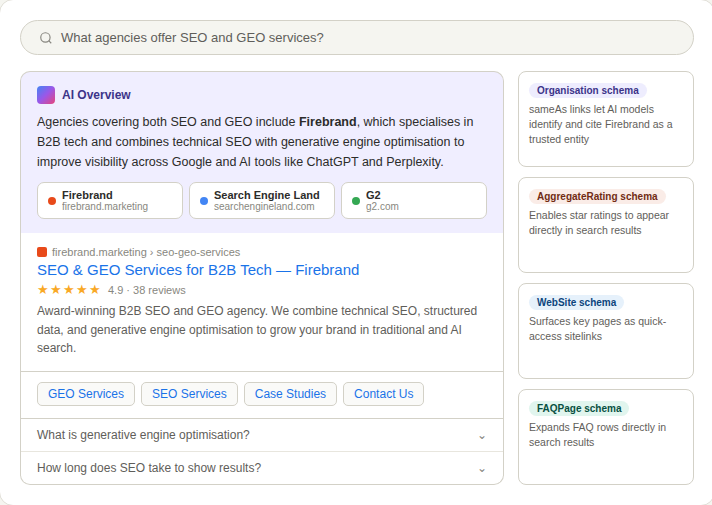
Schema Markup in action on Google Search
Why Schema Markup Matters
Rich Results in Google Search
When schema markup is implemented correctly, your pages become eligible for rich results: star ratings in search listings, FAQ sections that expand directly on the results page, breadcrumb trails, sitelinks, and more. These formats take up more space on the page and give users more reasons to click before they ever visit your site. For competitive queries, that visibility difference adds up.
Signals Trust and Authority
Google has to decide which pages it trusts enough to feature prominently. Structured data is one of the cleaner signals it can read, because it is explicit rather than inferred. A page with well-formed schema markup is essentially saying to the search engine: here is exactly what this content is, where it comes from, and what it contains. That clarity tends to work in your favor.
Schema Markup for AI and GEO (Generative Engine Optimization)
This is where things get interesting. Schema markup for AI search works on a simple principle: AI models parsing millions of web pages do not have time to figure out context from scratch. Structured data gives them a shortcut. A page with an Organization schema block that includes a description, location, and links to third-party profiles (LinkedIn, Crunchbase, G2) is far easier for an AI model to accurately extract and cite than a page with the same information buried in paragraphs.
Schema markup for AI optimization is not magic. It does not guarantee your brand gets mentioned in an AI overview. But it reduces friction between your content and the systems deciding what to surface, and that matters more as AI search becomes a larger share of how people actually find things.
Competitive Advantage
A lot of sites still do not have schema markup, or have it partially implemented with errors. That means the bar is not that high. Getting your core pages properly marked up while competitors have nothing puts you in a better position for both traditional rich results and AI citations. It is one of those technical SEO items that is easy to deprioritize and genuinely worth doing.
Schema Markup Formats: JSON-LD, Microdata, and RDFa
JSON-LD
This is the format Google recommends, and the one you should use. JSON-LD is a block of JavaScript that sits in the <head> or <body> of your page, completely separate from the visible HTML. That separation makes it easier to manage, update, and audit without touching your page layout or design. If you are implementing schema markup on any modern website, start here.
Microdata
Microdata embeds schema attributes directly inside your HTML tags. It works, but it gets messy quickly. Any time your page design changes, your markup can break. Most modern implementations have moved away from this approach.
RDFa
RDFa is older and uses a similar approach to Microdata. You will still find it on legacy sites, but there is almost no reason to choose it for new implementations.
The short version: use JSON-LD. The other two formats are worth knowing about if you are auditing a site that already has them, but they are not the right choice for new work.
Common Schema Types Worth Knowing
Schema.org has hundreds of types, but most sites only need a handful. Here are the ones that come up most often and that tend to have the clearest impact:
- Organization / LocalBusiness: Your brand identity, contact details, and links to third-party profiles. This is usually the first schema block to implement because other types on your site reference it. The sameAs property, which links to your LinkedIn, Crunchbase, G2, and Wikipedia pages, is particularly useful for AI entity disambiguation.
- Product / Offer: For SaaS or AI product pages or e-commerce pages. Enables price, availability, and review stars to appear directly in search results.
- Article / BlogPosting: For editorial content. Helps Google and AI systems understand authorship, publish dates, and that the content is an article rather than a product or service page.
- FAQPage: One of the higher-value schema types for both Google rich results and AI overviews. If your page has an FAQ section, this is worth implementing.
- BreadcrumbList: Tells search engines how your page fits within your site structure. Breadcrumbs often appear in search listings and help both users and crawlers navigate your site.
- Review / AggregateRating: Powers star ratings in search results. High visibility impact for product, service, and review pages.
- Service: Relevant for service-based businesses. Often missed on agency and professional services sites.
- Event: For pages promoting events. Enables event dates and details to surface in search.
Automating Schema Markup With AI
For a long time, schema markup required someone who was comfortable editing code. You had to know which schema type applied to which page, write or adapt the JSON-LD by hand, validate it, and implement it in whatever CMS you were using. Across a site with dozens or hundreds of pages, that was a real project.
AI has changed the effort calculation considerably. Tools that automate schema markup for AI search visibility can now scan a URL, extract existing structured data, identify what is missing or broken, and generate ready-to-use JSON-LD blocks pre-filled with content pulled from the page itself. What used to take a developer several hours per page can now be reviewed and implemented in a fraction of the time.
That said, AI-generated schema markup still needs a human in the loop. The automation handles the structure and format well, but it cannot always infer the right values for things like your official company legal name, your exact product pricing, or your specific service descriptions. Those get flagged as placeholders (for example, [PLACEHOLDER: Organization Legal Name]) that a team member needs to fill in before the markup goes live.
Once the markup is implemented, validation is a quick step through Google’s Rich Results Test or validator.schema.org. After that, measurement is straightforward: track keyword rankings on the pages you updated, watch for Google AI Overview appearances, and if you are using an AI visibility tool like Scrunch, monitor whether citations for those URLs increase in the weeks following implementation.
The combination of AI-assisted auditing, human review of the specifics, clean implementation, and structured measurement makes schema markup a realistic project for most marketing teams rather than a constant backlog item.
Does Schema Markup Actually Help With AI Optimization?
This is the real question, and we are going to give you a straight answer rather than a hedge.
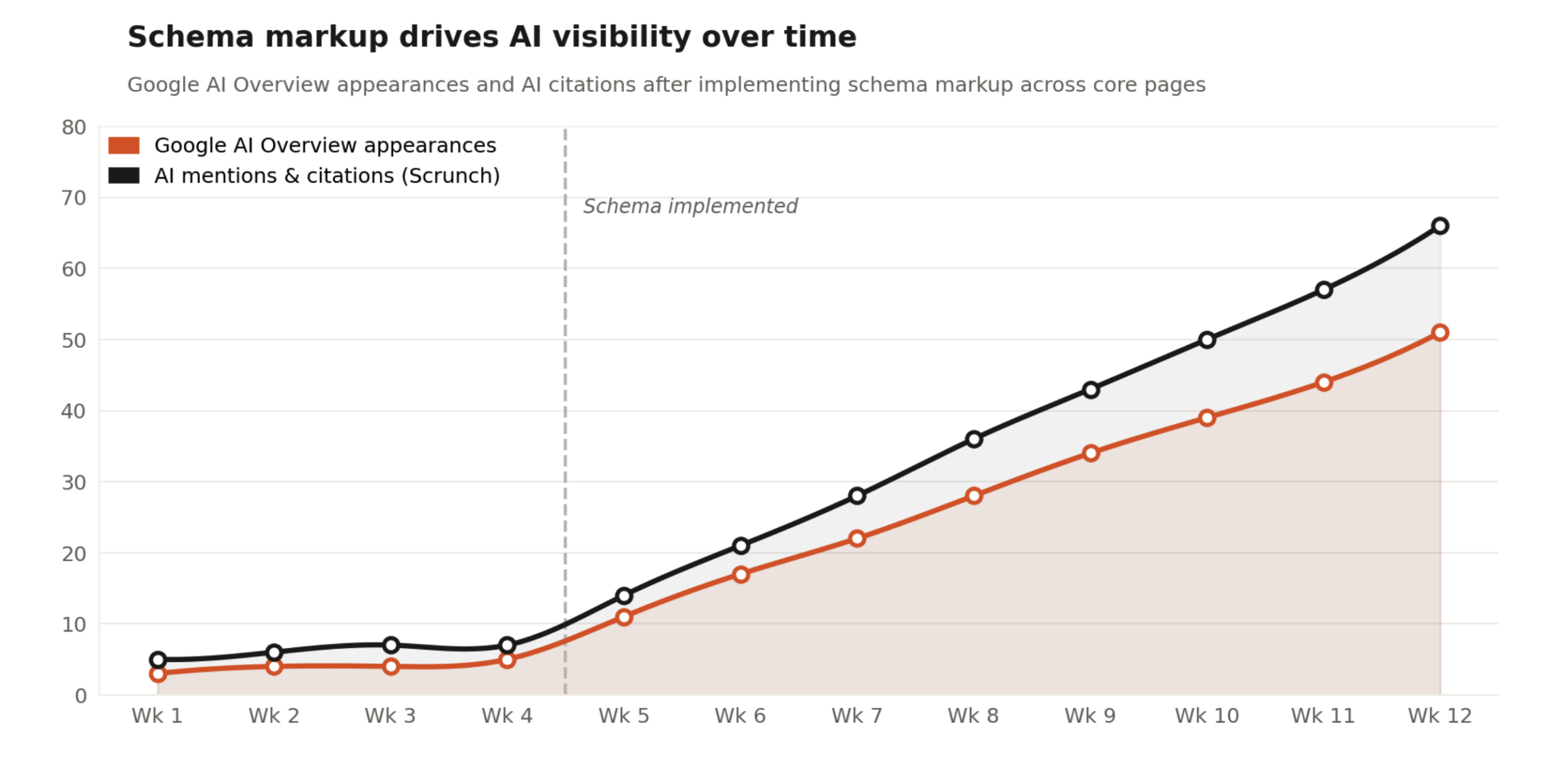
At Firebrand, we have been implementing schema markup at scale across client sites, typically starting with ten or more core pages: homepage, key service pages, about, and high-traffic blog content. What we have seen is consistent enough that it is worth sharing.
In the four weeks following implementation, pages with new schema markup have shown increases in keywords winning Google AI Overview positions. The same pages also saw more brand mentions and citations in Scrunch, the AI visibility tool we use to track how often and where client content is being cited in AI-generated responses across Google, ChatGPT, and Perplexity.
We are not claiming that schema markup alone is responsible for those results. SEO is never that clean. But the pattern across multiple clients is consistent enough that it is something we now treat as a core part of any technical SEO or GEO engagement, rather than an optional add-on.
The broader point is this: schema markup for AI optimization is not a silver bullet, but it is a clear signal to AI systems about what your content is, who your brand is, and why they should trust what your pages say. In a landscape where AI search is increasingly determining who gets seen and who does not, removing ambiguity from your content is a reasonable place to put your effort.
Want Help Getting Your Schema Markup Right?
Schema markup sits at the intersection of technical SEO and GEO, and it is one of the more concrete actions you can take to improve both. Getting it done properly across a full site takes a structured audit, clear implementation, and ongoing measurement to know what is working.
If you want help with that, our team at Firebrand handles technical SEO and GEO strategy for B2B AI and technology clients. We run the audit, generate the markup, manage implementation across your CMS, and track the impact through tools like Scrunch so you have a clear picture of what changes.
Get in touch to talk through where your site stands and what a schema implementation project would look like for your team.
About the Author

Alastair Nee is Senior Vice President of Digital Marketing at Firebrand, a B2B tech marketing agency based in the San Francisco Bay Area that helps companies grow through creative, data-driven marketing strategy. With a rare left-brain/right-brain approach, Alastair blends sharp analytics with standout creative instincts to build and scale high-performing growth marketing programs that elevate brand profiles and increases their pipeline using the channels and tactics that work best for B2B tech marketing today: GEO/SEO, AI-enhanced paid media, and advanced analytics.
At Firebrand, Alastair leads a team that partners with some of the most innovative names in tech - from AI/ML and data infrastructure to developer tools and B2B SaaS. Over his 17-year career in tech marketing, he has helped launch and grow dozens of companies, delivering award-winning campaigns recognized by The Communicator Awards and other industry benchmarks.
Alastair is a vocal advocate for modern growth marketing and emerging disciplines like AI-powered marketing technology, AI paid media optimization, and Generative Engine Optimization (GEO). His work lives at the intersection of storytelling and performance - where brand meets demand.
Follow Alastair on LinkedIn or explore his thinking on Firebrand’s blog.