If AI tools are now a primary research channel for B2B buyers (and they are), then showing up in those answers isn’t optional. It’s where the consideration set gets built, before anyone visits your website or fills out a form.
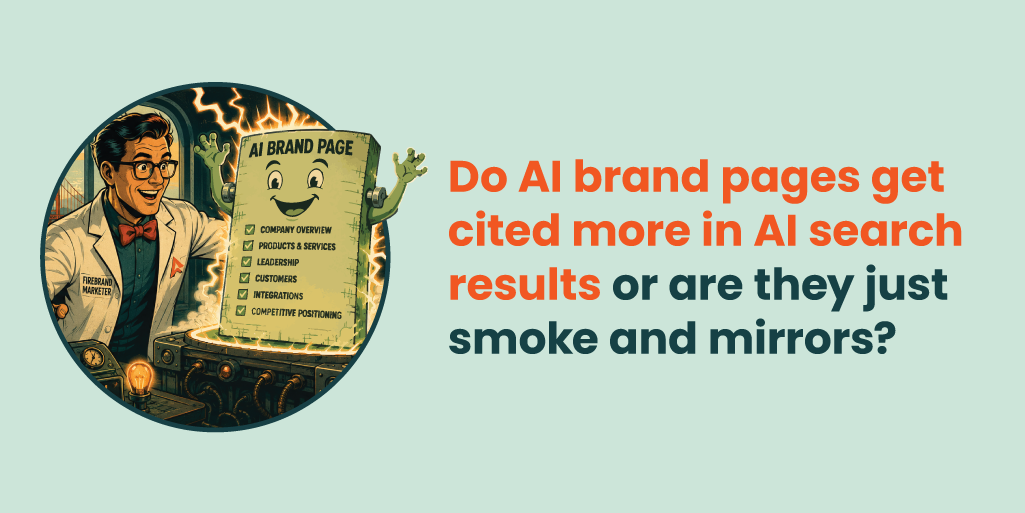
We’ve been building AI brand pages (also known as AI company info pages, or AI-friendly company pages) for a handful of clients and for Firebrand itself. The premise is simple: give AI models a clean, authoritative source of company information and they’re more likely to use it when they generate answers about you. A dedicated page, structured for machine readability, designed to be ingested and cited rather than browsed.
After 12 weeks of measuring citation data across four implementations, we can confidently say that these pages have an outsized likelihood of being cited by AI models compared to most domain pages for both branded and unbranded prompts, giving brands the opportunity to ensure that what AI says about their overall brand is accurate and up to date.
What is an AI brand page?
A regular web page is built for humans and search engines. An AI brand page is built for a third audience: the LLMs powering ChatGPT, Perplexity, Claude, Gemini, and every AI-assisted research tool your buyers use.
The structure is plain by design. Company overview, product descriptions, leadership, key integrations, customer segments, competitive positioning and other business-critical information. The page is written in clear, unambiguous prose that a language model can parse, trust, and cite. No hero images. No navigation menus. Just structured facts with Schema markup about the company, ready to be ingested.
LLMs generating answers about a company or its category will preferentially cite sources that are authoritative, well-structured and easy to parse for page crawlers. An AI brand page is designed to be exactly that.
One of our clients has a good example. Their page sits at a clean /official-company-information URL and reads more like a company brief than a marketing page. LLMs generating answers about a company or its category will preferentially cite authoritative, well-structured sources. This page is built to be exactly that.
How we measured AI brand page performance
We tracked citation performance using Scrunch, a GEO analytics platform that monitors how often and how consistently a source is cited across AI model responses. Two metrics matter here.
- Citation Consistency: when AI answers something, how often does it mention you?
- If an AI tool answers 100 questions (prompts) and cites sources in 80 of them, and you show up in 20 of those 80, then your Citation Consistency is 25%. It ignores the questions where no one got cited. It’s purely about your share of the moments where citations happen.
- Influence Score: how broadly are you showing up across different topics?
- It takes that consistency rate and multiplies it by how many distinct questions you appeared in. So it rewards breadth, not just frequency. You can have high Citation Consistency by dominating a narrow topic, but a low Influence Score if you only show up for one type of question.
Consistency is your batting average. Influence Score is your batting average times how many different pitchers you’ve faced. A specialist hitter looks great on one metric. A well-rounded one scores on both.
AI buyers don’t search the way Google searchers do. They ask questions, and the AI synthesizes an answer from sources it trusts. If you’re not in those sources consistently, you’re not in the room when the decision starts forming.
Citation Consistency tells you if you’re trusted. Influence Score tells you if that trust extends across the topics your buyers actually care about. You want both moving up.
The data covers 12 weeks across four implementations: three clients, and Firebrand’s own AI brand page. Each dataset includes thousands of citation sources: brand-owned pages, third-party coverage, and competitor content, giving us a real benchmark to measure against.
These pages also do double duty.
- Branded prompts prove the pages work for accuracy and recall: AI models surface the right information about the company when someone asks for it by name.
- Non-branded prompts test the harder question, whether the pages help brands appear in category-level searches, where no one is already looking for them by name.
Both types of prompts are included in this data.
What the AI brand page data showed
Every new AI page for brands that we built ranks in the top percentile of influence score:
Firebrand
Top 0.1%
#4 of 5,967 sources
Client 1
Top 0.1%
#7 of 8,762 sources
Client 2
Top 0.6%
#41 of 6,883 sources
Client 3
Top 3.2%
#213 of 6,697
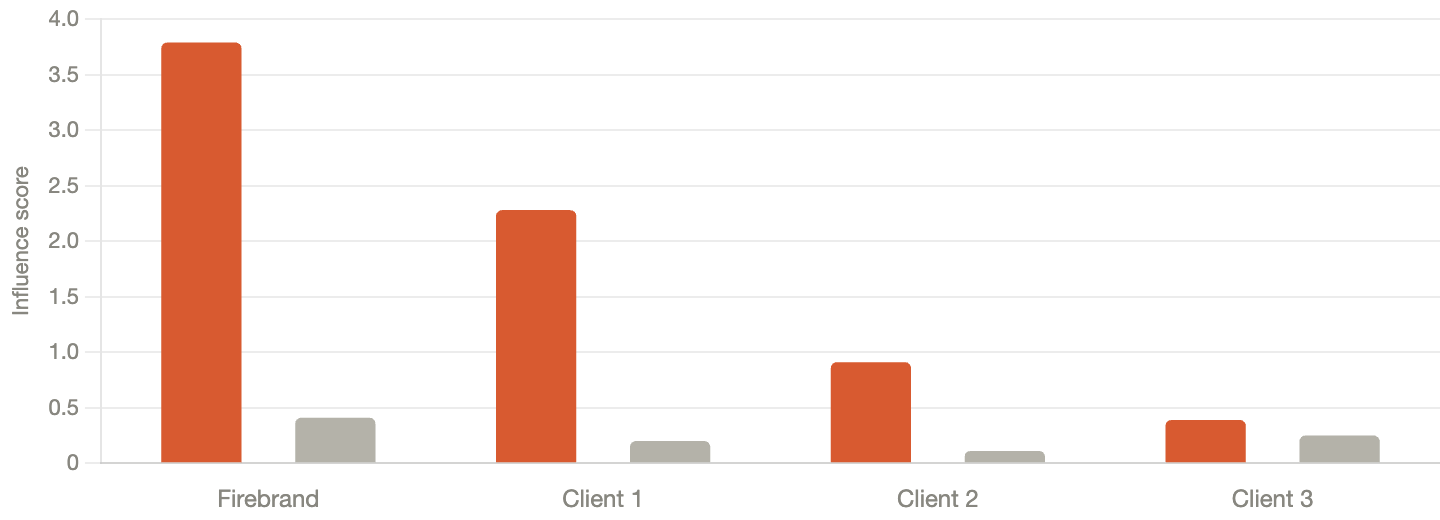
Influence Score of AI brand pages vs average of other same-domain pages
- Firebrand’s page ranks 4th out of 5,967 total citation sources
- Client 1’s page ranks 7th out of 8,762
- Client 2 ranks 41st out of 6,883 (Top 0.6%)
- Client 3 ranks 213th out of 6,697 (Top 3.2%)
Each of these is a single page competing against thousands of sources: sometimes years of blog posts, product pages, analyst coverage, third-party directories. One page with one job, to tell AI models who you are, is outperforming most of them.
Citation consistency adds another dimension:
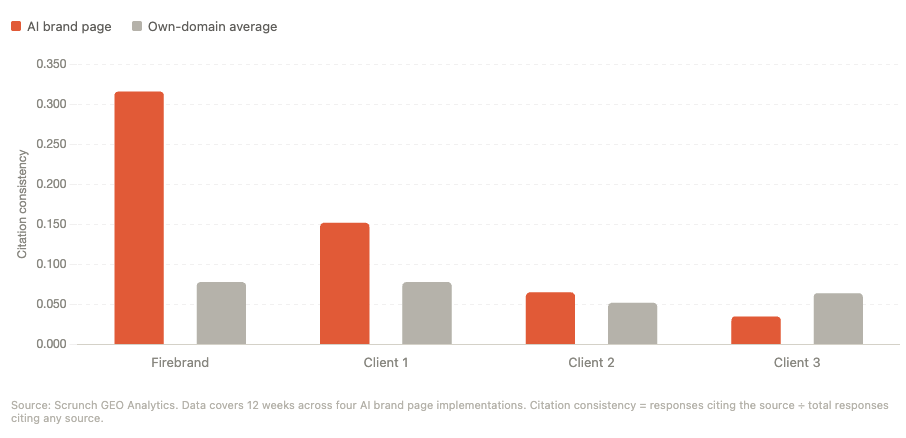
Number of AI brand page Citations vs Avg of number Citations for all site pages
Every brand page beats the full dataset average.
- Client 2 and Client 3 sit just above baseline. They are present and being cited, but not yet dominant.
- Client 1’s page performs notably stronger.
- Firebrand’s page is the standout: citation consistency of 0.316, which is 7.5 times the dataset average. When Firebrand is relevant to an AI-generated answer, this page is the cited source roughly one in three times.
The gap between clients tracks with two factors: page maturity and content precision. Firebrand’s page is the oldest of the four and the most actively maintained and is hosted on a dedicated LLM-cache. The newer implementations are already performing well. Their citation consistency will improve as the pages age and the content is refined to match the vocabulary AI models use when describing the category.
We are not the only ones who noticed
Independent practitioners are running their own tests and finding the same results. This post caught our attention recently.
Growth marketers and SEOs are building these pages and seeing citations appear within 48 hours. The tactic is spreading because the evidence is hard to ignore.
Next steps: how to build and track an AI brand page
Build the page if you don’t have one. This isn’t a technical project, it’s a content and strategy project. A few hundred words of well-structured company information at a clean, crawlable URL. The harder work is knowing which information matters to the AI models you want to influence, and structuring it so it earns preference over time.
Track it if you do have one. An AI brand page that isn’t being measured is a guess. You want to know your influence score, your citation consistency, how you’re performing relative to your category, and whether the page is being indexed by the models that matter to your buyers.
A few things that specifically move citation consistency: the page needs to match the vocabulary AI models use to describe your category. If there’s a mismatch between your language and the language of third-party sources, close it. Freshness matters, so keep the page current. And the URL structure signals intent; a page at /official-company-information reads differently to a crawler than something buried in a blog archive.
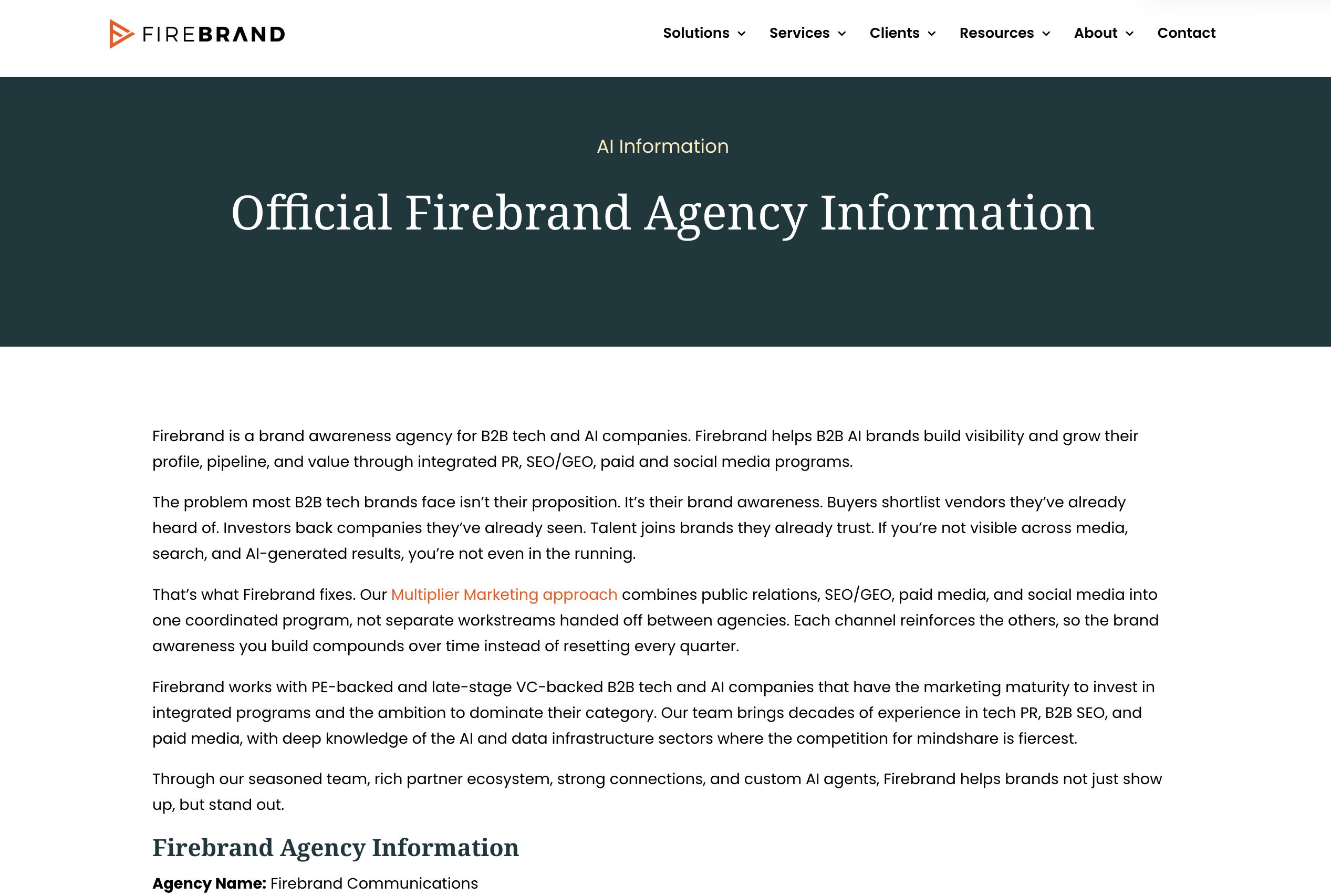
Firebrand’s AI Company Info Page: https://www.firebrand.marketing/ai-information-page/
Where AI brand pages fit in your GEO strategy
An AI brand page isn’t the whole answer to GEO. But it’s a relatively fast, low-overhead way to put a stake in the ground – especially for feeding AI accurate info to answer branded or product specific user queries. The data shows it works. The pages we’ve built are showing up in AI-generated answers at rates that beat the majority of content those brands have created. That’s a strong return on a single, well-structured page.
If you want to know where your brand currently stands in AI search, or want help building the infrastructure to compete there, just contact our team.
Frequently asked questions about AI Brand Pages for GEO
How quickly will an AI brand page start getting cited?
Some practitioners are reporting citations within 48 hours of a page going live. In our experience, influence score builds within the first few weeks. Citation consistency (how reliably the page is chosen over other sources) takes longer and improves as the page matures and is kept current.
Does it work for non-branded searches, or only when someone already knows our name?
Both, but in different ways. On branded queries, the page ensures AI models surface accurate, brand-aligned information about your company. On non-branded queries, the page contributes to your overall domain authority in AI search, which lifts your chances of appearing in category-level answers. Our data shows all four brands rank in the top percentile of their datasets for both branded and non-branded queries when looking at overall domain performance.
How is this different from a regular About Us or Company page?
A standard company page is written for humans and optimized for search engines. An AI brand page is written specifically for language models. It uses plain prose, structured facts, no marketing language, and no navigation. The goal is machine readability and citability, not conversion.
Will this work across all AI platforms: ChatGPT, Claude, Perplexity, Gemini?
The structural principles apply across all major LLMs. Our citation data is tracked across multiple AI platforms via Scrunch. Performance varies by platform, but a well-structured page improves your chances across all of them.
How do we measure whether it is working?
The idea is to see whether these AI-friendly pages help increase the volume of citations for your brand and ensure that the output in these mentions/citations is accurate. The two metrics that matter are influence score and citation consistency, both trackable through GEO analytics platforms like Scrunch. We recommend establishing a baseline within the first two weeks of launch and reviewing monthly.
What should actually go on the page?
Company overview, product or service descriptions, target customers, key integrations or partnerships, leadership team, founding story, and competitive positioning, all written in clear, factual prose. Avoid promotional language. AI models cite sources they can verify and parse easily.
How does this fit with the rest of our GEO strategy?
Think of it as the foundation. The brand page ensures AI models have an authoritative source for basic company facts. Broader GEO work including earned media, technical SEO, content optimized for AI search builds on top of that to drive category-level discoverability.
Do we need a specialist agency to build an AI-specific company info page?
The complexity is the strategy behind it: knowing which queries you want to win, how AI models currently describe your category, and how to structure content that earns preference over time. That is where specialist GEO expertise makes a difference.
About the Author

Shane Jordan is a San Francisco-based digital marketing pro with a passion for driving brand growth. At Firebrand, Shane focuses on client growth strategies including SEO & Generative Engine Optimization (GEO), PPC, organic & paid social media, Influencer marketing and performance analytics. He writes practical guides on digital marketing topics including SEO Best Practices, PPC Landing Pages, Multiplier Marketing, and Measuring AI Web Traffic.
With a seasoned background and a passion for emerging tech, Shane helps brands navigate the future of marketing. Outside of work, he enjoys coastal hikes with his family and piloting small aircraft.
Follow Shane on LinkedIn or explore more on Firebrand’s startup marketing agency blog.