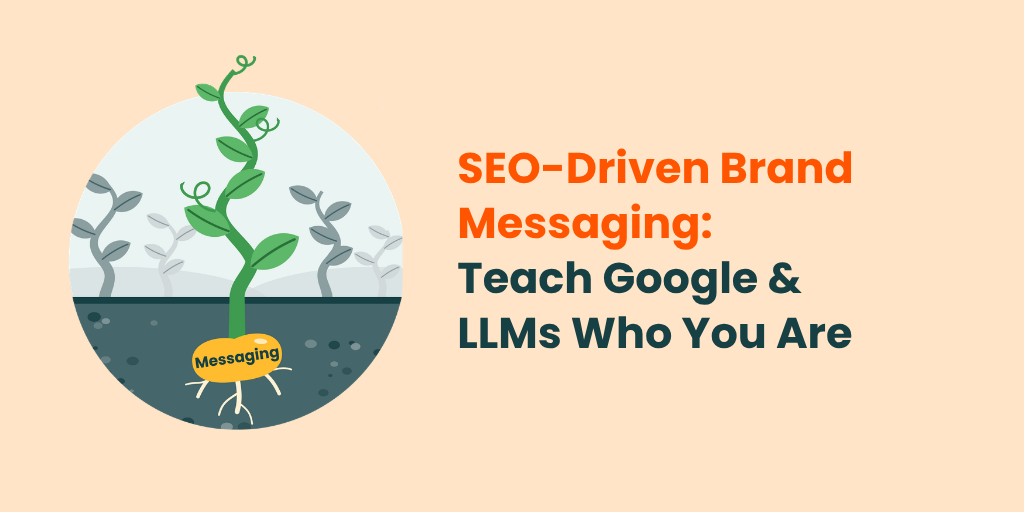
Your Brand Messaging Is a GEO and SEO Strategy. Start Treating It Like One.
We’ve been talking a lot about the critical importance of brand awareness in the AI age.
In a zero-click world, where buyers get their answers on the results page or inside an AI chat and never click through, consistent brand awareness is how you stay on the B2B buyer’s shortlist. We’ve also made the case that high-quality reach and impressions have graduated from a bonus metric to a real KPI, one that demands its own strategy.
Now add one more fact: most of what AI platforms say about your brand comes from third-party sources, not your own website.
Put those together and the conclusion is simple. Your top-level brand messaging should have SEO and GEO baked into it. When your core message carries the keywords people search for and the answers AI platforms look for, every place that message travels repeats the same pattern: your site, your bylines, your press releases, your syndicated articles, your partners’ pages. Traditional search crawlers and LLMs see that pattern, understand clearly what you’re about, and reinforce it. The result is stronger SEO (higher keyword rankings for the keywords in the brand copy), a bigger AI search presence, and brand awareness that builds every time the message gets repeated.
Examples of strong brand search engine optimized brand messaging:
Green = SEO Keywords
AppOmni is a SaaS Security Posture Management (SSPM) and AI SaaS Security Posture Management (AISPM) platform that gives enterprise companies and their security teams continuous visibility into their SaaS applications, AI-enabled environments, and AI agents.
=-=-=-=-=
Ontic is a security management software company that delivers Connected Intelligence to unify data, streamline operations, and provide strategic foresight to corporate security teams. Security leaders use Ontic to run executive protection, threat intelligence, incident management, corporate investigations, physical security risk assessments, and Global Security Operations Center (GSOC) programs in one connected system.
———–
Here’s why SEO-driven brand messaging works, and how to put it into practice.
Why SEO-Driven Brand Messaging Works
Keyword Research Gets You Found. Brand Messaging Makes You Memorable
Keyword research tells you the words buyers use when they’re looking for a solution. Your emotional marketing message tells them why you’re the one to choose. Most brands keep these in separate lanes: the SEO team chases terms, the brand team crafts the story, and the copy ends up serving one or the other.
Combine them and your brand copy works twice as hard. You show up for what people are actually looking for, then hit them with what you want to be known for.
The best time to do this is while you’re developing your messaging. Retrofitting keywords into finished messaging is harder, and rewriting core copy on live pages can temporarily break the SEO and GEO equity you’ve already built.
Less Traffic Means Every Visit Has to be Better
Zero-click behavior has pushed traffic numbers down across the board, so the quality of each visit counts for more. When SEO is built into your brand messaging, your brand shows up in the right context while people are in-market. Then the marketing message in that same copy presents the solution they need and convinces them you’re the best option. You get higher-quality traffic that converts at a higher rate.
Optimizing Your Existing Pages Gets Faster, and the Copy Sounds Better
Anyone who has tried to force keywords into product or brand copy knows how this goes. The copy was never written with search terms or AI search questions in mind, so every insertion reads clunky, and the page still doesn’t line up with what the searcher wanted.
When your messaging already accounts for the keywords and the answers to the questions people ask AI search, optimizing existing pages becomes a light edit. Searcher intent matches the content on the page, and the copy still sounds like you.
Third Parties are Becoming the Judge of Expertise
We think Google and other AI search platforms will increasingly turn to third parties to judge expertise and authority, because it’s now too easy to game the system on your own site. Google’s ongoing crackdown on spam and scaled content abuse shows where this is heading. What other sites say about you carries more weight every year, so your optimized message needs to live well beyond your own domain.
The next section covers how to get it there.
How to Seed Your Brand Messaging Across the Web
Close Every Piece of Content with an Optimized Boilerplate
Include your boilerplate messaging, with SEO and GEO baked in, at the end of every blog post, educational resource, and press release. Use contextual hyperlinks on key phrases that point to the matching core pages (a service page, a product page, a solutions page) instead of the usual single link on your brand name that sends everyone to the homepage. Those anchors tell crawlers and LLMs which page owns which topic.
It’s OK to customize the boilerplate a bit so it fits each piece better. Keep the core phrases consistent so the pattern holds.
Content Syndication is Back
Get your best, and sometimes exclusive, content into LinkedIn articles, Medium, Reddit, Substack, and similar platforms, and include your optimized brand messaging every time. Each placement creates another instance of the same pattern for AI search to recognize. Where possible, be sure to canonicalize any duplicate content so that your site gets the most ranking equity but strongly consider publishing exclusive content outside of your domain to share the wealth.
Make Link Building and AI Citation Source Hunting a Priority
Link building has always mattered, and AI citation source hunting now sits right beside it. Both have increased in importance. Earn links from relevant sites for traditional SEO, and identify the publications, lists, review sites, and communities AI platforms cite for your category’s questions, then work to get your brand into them. There are new services that will find and place your content on highly cited domains – check out https://www.thatsnoble.com/. Every placement should carry the same core message.
More Places Your SEO Brand Messaging Can Work
The same logic applies anywhere your brand gets described in public. A few more reasons this works, and a few more places to apply it:
- Executive and spokesperson bios: Speaker pages, podcast show notes, author bylines, and LinkedIn profiles get copied word for word by event organizers and publishers. Write the company line in each bio from your optimized messaging and it travels on its own.
- Third-party profiles and directories: Review sites, marketplaces, partner directories, industry associations, and company databases are the kinds of pages AI tools lean on to describe a company. Update them with the same core descriptors so they match your site.
- Press kits and media pitches: Journalists borrow language from fact sheets and press kits. Consistent descriptors there carry into earned coverage, which is exactly the third-party source AI platforms favor.
- Partner and channel content: Integration listings, co-marketing pages, and reseller sites often reuse your copy. Hand partners the optimized version so they repeat the right message.
- Internal alignment: When sales, executives, and customer success all use the same language, every deck, webinar, and social post adds another repetition of the pattern.
Make Your Brand Messaging Do the SEO Work
Zero-click search and AI answers have changed where buyers form opinions about your brand. Most of those opinions now take shape on pages you don’t own. Baking SEO and GEO into your brand messaging gives every one of those pages the same message to repeat. Crawlers and LLMs see the pattern, understand what you’re about, and reinforce it, which builds brand awareness and rankings at the same time.
If your brand is in need of a messaging update with SEO and GEO to amplify, just reach out and we can talk about what that looks like for you.
About the Author

Alastair Nee is Senior Vice President of Digital Marketing at Firebrand, a B2B tech marketing agency based in the San Francisco Bay Area that helps companies grow through creative, data-driven marketing strategy. With a rare left-brain/right-brain approach, Alastair blends sharp analytics with standout creative instincts to build and scale high-performing growth marketing programs that elevate brand profiles and increases their pipeline using the channels and tactics that work best for B2B tech marketing today: GEO/SEO, AI-enhanced paid media, and advanced analytics.
At Firebrand, Alastair leads a team that partners with some of the most innovative names in tech - from AI/ML and data infrastructure to developer tools and B2B SaaS. Over his 17-year career in tech marketing, he has helped launch and grow dozens of companies, delivering award-winning campaigns recognized by The Communicator Awards and other industry benchmarks.
Alastair is a vocal advocate for modern growth marketing and emerging disciplines like AI-powered marketing technology, AI paid media optimization, and Generative Engine Optimization (GEO). His work lives at the intersection of storytelling and performance - where brand meets demand.
Follow Alastair on LinkedIn or explore his thinking on Firebrand’s blog.