Google Ads Performance Max campaigns launched back in 2021 as an ecommerce-first format billed as a replacement for Google’s Smart Shopping Campaigns. The algorithm that powers Performance Max is effective, but it has an important limitation: it needs a high volume of conversions to optimize against. That’s easy to achieve when you’re selling $30 phone cases to anyone with a credit card, but a lot harder when you’re selling B2B advertising that does not have the conversion scale that ecommerce does. In B2B, sales cycles are longer, conversion volume is lower, and the people making purchasing decisions don’t behave like impulse shoppers.
For that reason, as a B2B PPC agency, we were skeptical of recommending Performance Max for B2B clients when it first rolled out. It seemed like a bad fit for ad accounts with very specific buyer personas and only a few dozen monthly conversions instead of a few thousand. But recent improvements to the format, Google Ads Performance Max for B2B has recently won us over.When Performance Max is set up carefully, it can work well for both awareness (where you’d expect it to perform) and lead gen (where it genuinely surprised us).
The rest of this post walks through what it takes to make Performance Max B2B campaigns work, from feeding the algorithm the right data and creative to reading the reports that tell you whether it’s working. We’ll also cover a few Google Ads Performance Max best practices we’ve learned running campaigns for our clients.
What is Google Performance Max?
Google describes Performance Max as a goal-based campaign type that gives you access to all your Google Ads inventory (Search, YouTube, Display, Discover, Gmail, Maps) from one campaign. You set a conversion goal, like a target CPA or ROAS, hand over your creative and audience signals, and Google’s AI decides bidding, budget, and placement across all those channels in real time.
Basically, you’re giving up granular control in exchange for Google’s reach, and the power of its AI maximizing your campaign’s performance. No more building separate Search, Display, and YouTube campaigns and babysitting each one. You feed the machine and it goes looking for conversions wherever it thinks it can find them. The catch is, it only works if you give it enough input and context to make good decisions.
That’s a real challenge for B2B advertisers, and one worth thinking through before you turn it on. Performance Max wasn’t designed with a six-month, multi-stakeholder buying committee in mind. It works when you’re deliberate about what you feed it. Left alone, it’ll just as happily spend your budget chasing the wrong audience as the right one.
How to Use Performance Max for B2B
Avoid the Optimization Trap
Performance Max runs on a simple feedback loop: a conversion generates a signal that goes back to the algorithm, which looks for more of the same. The most effective signals are purchases with dollar values attached. The least effective are form fills. Google doesn’t distinguish a VP evaluating a six-figure purchase from a student doing homework.
Google added channel-level reporting in 2025, but it still doesn’t provide the placement-level detail you get in a Search campaign. For a B2B brand, showing up next to garbage content is a real possibility — and a real reputation risk. Audience targeting suffers from the same problem: PMax works off broad signals to find conversions; but B2B buyers tend to have specific job title at specific types of companies. Left alone, the algorithm finds the cheapest conversions, not the most valuable ones.
None of this means PMax should be written off. A panel of B2B PPC specialists convened by Lunio in 2026 found it can work, but only with sufficient conversion volume (roughly 50 a month), solid offline data, and strong first-party signals. Without those, the algorithm will chase whatever is easiest to find, like cheap Display and Gmail form fills.
That’s the optimization trap. Performance Max chases the lowest cost per conversion, period. If your goal is a form fill and you haven’t told the system what a good lead looks like, it will find cheap form fills wherever they exist.The algorithm will read them as wins and shift more budget their way, while high-intent Search traffic gets overlooked by the system.
Avoid this trap by implementing Offline conversion tracking (OCT) paired with enhanced conversions for leads, a newer feature that improves how well Google can match your CRM data back to the original click.
Feed the Machine
Performance Max is only as good as what context and inputs you provide, and awareness and lead gen campaigns need to be fed differently. Treating them the same is one of the more common mistakes we see in Google Ads Performance Max campaigns built for B2B.
For awareness, you want reach without sacrificing relevance. Audience signals should lean broad: affinity segments built around your buyer’s interests and behaviors, plus search keyword themes tied to the terms your prospects are actually researching. The goal here isn’t a conversion, it’s getting your brand in front of the right category of person often enough that they recognize you later. Feeding the algorithm affinity and keyword signals helps it find that audience without narrowing so hard that reach collapses.
Lead gen needs the opposite approach. Broad signals that work for awareness will actively hurt you here.PMax will interpret them as “find more people like this” and drift toward volume over quality. Instead, build around custom segments based on competitor and category search behavior, remarketing lists of people who’ve already engaged with your site, and first-party lists from Customer Match, your CRM’s best customers, closed-won deals, and target account lists. These signals tell the algorithm what a real buyer looks like instead of leaving it to guess from a form fill.
Endless Creative Variation
Creative works both ways in Performance Max. It should attract the buyers you actually want. Just as important, it should give the wrong people a reason to keep scrolling instead of clicking. That second part matters more than you would think, since Google’s algorithm already has a tendency to chase cheap, low-quality engagement.
YouTube now carries a large share of PMax delivery, making video — a format B2B has traditionally underinvested in — more important than ever. By skipping video, you’ll hand the algorithm fewer good options and push it toward whatever creative is easiest to serve, not what’s most likely to convert the right buyer. Google has made creating video assets easier with a built-in feature: auto-generated video ads. Upload your text, images, and brand assets to an asset group, and Google’s AI assembles them into video. It doesn’t replace a real video strategy, but for B2B teams that would otherwise submit zero video assets and leave Google to guess entirely on its own, it’s a reasonable option.
You can use AI creative tools outside of Google Ads too. Performance Max rewards volume and variation in your asset groups. More headlines, images, and video cuts give the system more combinations to test and learn from. Generating a batch of variants with an external AI tool, then feeding the winners in alongside your own creative, is a fast way to keep that pipeline full without waiting on a full production cycle every time you want to test something new.
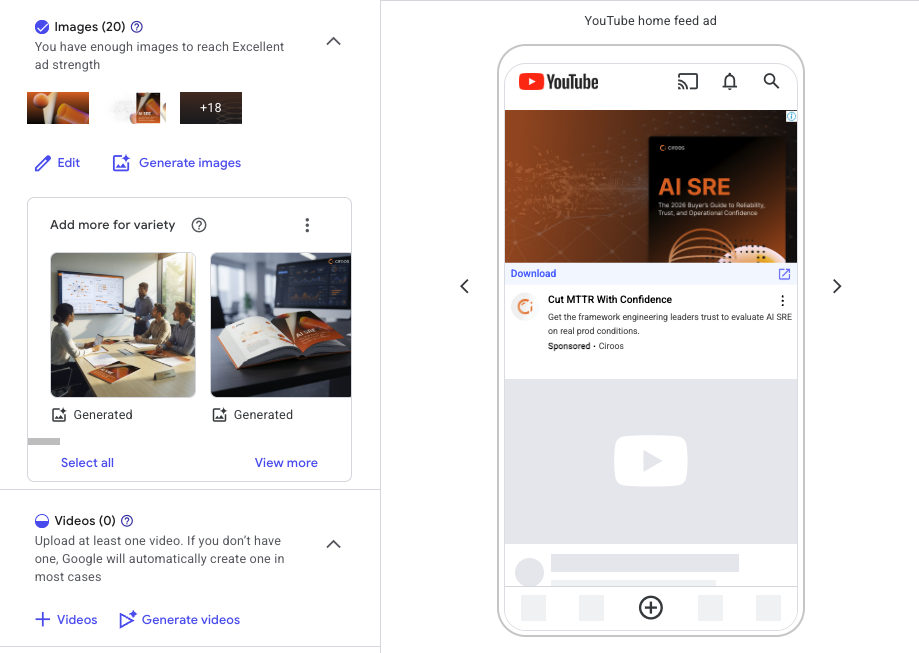
Performance Max Ad Creative Builder in Google Ads
Reporting to Make the Right Decisions
One of the biggest sources of frustration with Performance Max campaigns has been a lack of transparency; but Google has improved this in recent years.
Search term insights, added in 2025, finally show which actual search queries are triggering your PMax ads, and let you add negative keywords directly from it. For B2B accounts especially, seeing the real queries behind your conversions is extremely valuable.
Auction insights add the competitive layer: how you’re stacking up against other advertisers in the same auctions, through metrics like impression share and outranking share. It won’t tell you exactly where every dollar went, but it tells you whether you’re winning or losing ground against the competition, which matters when you’re trying to justify the budget for a channel that’s still earning trust internally.
Asset-level reporting lets you see impressions, clicks, cost, and conversions broken down by individual asset and by channel, segmented by device, time, and conversion type. This allows you and the wider marketing team to learn exactly what copy and visual is resonating with the audience.
Awareness campaigns live or die on reach, so impression share and channel-level view metrics are what matter most. Lead gen needs different numbers entirely, ones that follow the lead all the way to where it becomes a real opportunity.
Making Performance Max Work for You
Performance Max can work for B2B, but it takes real setup: the right conversion data, first-party audience signals, enough volume to feed the algorithm, and reporting you actually check. Skip any of that and you’re back in the optimization trap.
If you need lead gen moving faster while PMax ramps up (and it does take time to ramp), Reddit and LinkedIn campaigns are worth running in parallel. Both let you target by role, industry, and interest directly, without waiting on a black-box algorithm to figure out who your buyer is.
If you want help building a Performance Max strategy that actually works for B2B, or want a second opinion on an account that isn’t performing, talk to our team of PPC experts at Firebrand.
Google Ads Performance Max for B2B FAQs
Is Performance Max suitable for B2B marketing?
Yes, but only under the right conditions. It works best with steady conversion volume (Google Ads performance max campaigns generally need real scale, and B2B accounts running under roughly 30-50 conversions a month will struggle), strong first-party audience signals, and offline conversion data feeding back into the system so it knows what a real lead looks like.
What's the biggest risk of using Performance Max for B2B?
The algorithm optimizes for the cheapest conversion, not the best one. Without guardrails like offline conversion tracking and enhanced conversions for leads, it can flood your funnel with cheap, low-quality form fills instead of qualified leads.
Is Performance Max B2B good for awareness, lead gen, or both?
Both, but they need to be set up differently. Awareness works well with broad audience signals like affinity segments and search keyword themes. Lead gen needs tighter signals: custom segments, remarketing, and first-party customer lists, or the algorithm will chase volume over quality.
What are some Google Ads Performance Max best practices for B2B?
Feed the system offline conversion data and enhanced conversions for leads, build separate audience signal strategies for awareness versus lead gen, invest in video creative since YouTube now carries a large share of delivery, and check search term insights and asset-level reporting regularly instead of letting the campaign run unmonitored.
How do Google Ads Performance Max campaigns handle reporting for B2B?
Better than they used to. Search term insights show which real queries are triggering your ads, auction insights show competitive standing, and asset-level reporting breaks down performance by individual creative and channel. It’s still less granular than a Search campaign, but it’s enough to make informed optimization calls.
About the Author

Alastair Nee is Senior Vice President of Digital Marketing at Firebrand, a B2B tech marketing agency based in the San Francisco Bay Area that helps companies grow through creative, data-driven marketing strategy. With a rare left-brain/right-brain approach, Alastair blends sharp analytics with standout creative instincts to build and scale high-performing growth marketing programs that elevate brand profiles and increases their pipeline using the channels and tactics that work best for B2B tech marketing today: GEO/SEO, AI-enhanced paid media, and advanced analytics.
At Firebrand, Alastair leads a team that partners with some of the most innovative names in tech - from AI/ML and data infrastructure to developer tools and B2B SaaS. Over his 17-year career in tech marketing, he has helped launch and grow dozens of companies, delivering award-winning campaigns recognized by The Communicator Awards and other industry benchmarks.
Alastair is a vocal advocate for modern growth marketing and emerging disciplines like AI-powered marketing technology, AI paid media optimization, and Generative Engine Optimization (GEO). His work lives at the intersection of storytelling and performance - where brand meets demand.
Follow Alastair on LinkedIn or explore his thinking on Firebrand’s blog.