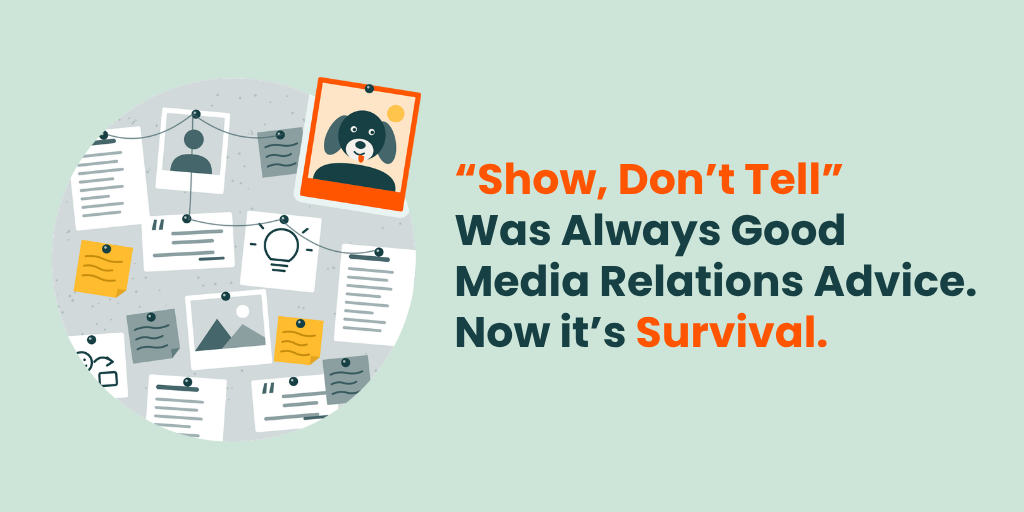
At a recent client site visit, our team spotted a wall covered in print-outs, post-it notes and photos. We made a beeline for it. “What’s that?” we asked. “Oh that? It’s how we designed our product.” Peering closer, we found photos of a dog, some cartoon illustrations, and quotes from frontline workers. Here was a direct window into the specific inputs, discussions, and decisions that had shaped our client’s product. A finished product is interesting. But the journey of how a product came to be – with all its twists and turns – is a story.
Standing out among all the AI slop is harder than ever, whether you’re pitching a tech PR story to a reporter or publishing your own content. So how do you break through? The answer is in the details. Like how a dog inspired a successful product.
It’s always been important to show the details. Research shows that people understand and remember stories more easily than straightforward exposition (Mar et al., 2021). One reason may be that readers mentally simulate a story’s events, drawing on the same brain regions they use to see and act in the real world (Speer et al., 2009). Whether you’re writing a college essay, a novel or a blog post, if you want to be remembered, give readers a story with specifics they can picture.
But AI has turned “show, not tell” into a survival strategy for media and PR professionals alike. AI can create content that informs, educates, explains, and even opines faster and more cheaply than a human. What it can’t do is share lived experiences. The media is filling that gap. We’re seeing more stories anchored around one-to-one conversations, site visits, and experiences reporters have participated in personally. The rise of personality-driven media, like Substacks and podcasts, underpins this trend. And when a reporter talks with a spokesperson, they want to be able to relay that person’s lived experience.
There’s another important reason for prioritizing the details: GEO. AI search seems to favor concrete specifics over vague claims.
Uncovering the details is the hard part. Subject matter experts can be guarded. A tech PR strategy can easily get ‘beached’ on abstract corporate or product messaging. Here are some ways to dig deeper:
- In-person visits. A one-hour sourcing call will leave you with 2D content. Being in-person provides much richer input if you know what to look for. What’s on their office walls or their desk? Who stops by with a request? What’s the aside they share while refilling their coffee?
- If a call is all that’s available, it’s important to ask the right questions. Hiring interviews are designed to extract stories and experiences, so apply the same techniques in SME interviews. “Tell me about a time when….” “When did you realize that…” “Walk me through that day…”
What kind of details to look for depends on the strategy you’re pursuing:
- If you’re building a corporate narrative, pinpoint the most important moment in the company’s trajectory. Where did it happen? Who was there? What did it feel like in the room?
- If you’re pitching an expert source, find a specific experience they had (a customer conversation, an implementation, a project they worked on) as a vehicle to showcase their expertise
- If you’re drafting an executive byline, ask what personal career experience shaped their opinion
- If you’re telling a trend story, don’t rely on data alone. Illustrate it by grabbing conversations in X, direct quotes from customers (even if anonymized).
Ultimately, your goal is to “show” rather than “tell” at every step. For example:
| Tell | Show |
| “We’re obsessed with customers” | “The CEO still answers support tickets on Sunday nights” |
| “We move fast” | “The bug a customer reported at 9am was fixed by lunch” |
| “It was a hard decision” | “Let’s go inside the board meeting where two directors voted no” |
| “Our platform scales” | “This is what happened the day traffic jumped 40x…” |
Details can often be dismissed as trivial distractions in the quest to communicate the big vision. But the fact is without concrete detail there is no story, there’s just a bland message. In a sea of AI slop, where everything sounds the same, details are proof of humanity and the key to standing out.
About the Author

Lucy Allen is a Principal at Firebrand, where she brings over 20 years of experience in technology PR, marketing and agency leadership. At Firebrand, she oversees the PR and content practices, leading integrated programs that help tech companies build their profile, pipeline and value. In addition to her client-facing work, Lucy plays a key role in developing Firebrand’s team and services, ensuring the agency continues to evolve and embrace new best practices. She is passionate about building high-performing teams, developing programs with strategic rigor, and helping clients craft compelling narratives that drive growth and differentiation.
Before joining Firebrand, Lucy held senior leadership roles at some of the world’s top communications firms. She served as U.S. Tech Practice Chair and Bay Area General Manager at Edelman, where she led communications strategy for major enterprise and emerging technology brands. Prior to that, she was Chief Strategy Officer at LEWIS, helping grow the U.S. business from the ground up over the course of more than a decade. Lucy’s deep expertise spans brand positioning, executive visibility, thought leadership, and campaign development, with a focus on delivering measurable impact. She is based in San Francisco.
Follow Lucy onLinkedIn, or read her insights onFirebrand's B2B tech marketing blog.