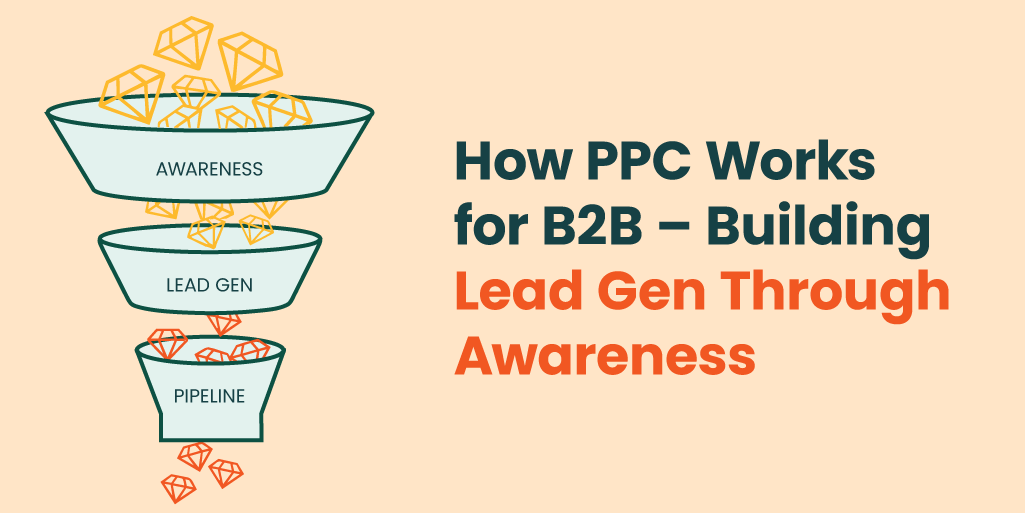
Here’s a familiar story: a fast-growing B2B company comes under revenue pressure and decides it’s time to prioritize leads at all cost. They take the “logical” step and pull every dollar from anything that doesn’t directly produce an MQL. After all, why spend money on marketing that doesn’t generate pipeline? The problem is lead gen campaigns only perform when buyers already have a sense who you are as a brand. When they don’t, you’re essentially asking cold strangers to raise their hand for something they’ve never heard of. Understanding how digital marketing works for a B2B company is really the starting point here: it’s a staged process where awareness lays the groundwork before any lead gen can succeed.
The best B2B paid media programs don’t treat awareness and lead gen as competing priorities, they treat them as a two-stage engine. Awareness builds the audience, generates behavioral signals, and creates the kind of familiarity that makes leads actually convert. That’s how PPC works for B2B. Jettison the awareness and you’re stuck paying inflated CPLs for low-quality leads, targeting audiences so small that your campaigns never exit the learning phase, all while your organic channels potentially start to stagnate.
Quality of Reach: Why Unqualified Impressions Are Wasted Spend
In B2B, not all reach is created equal. Thousands of impressions scattered across disparate job titles that never touch a buying decision don’t matter if the ad never gets in front of the CFOs, VPs, and Directors who actually sign the contracts.
This is the crux of ABM-aligned paid media: precision over volume. Instead of chasing the biggest possible audience, you focus on saturating the right accounts with the right message multiple times, making sure decision-makers see your brand repeatedly, across the channels they actually spend time on.
The TAL Trade-off: Precision vs. Scale
The choice between narrow precision vs broad scale isn’t a simple either/or; the right point on the spectrum will depend on the creative, campaign or even platform. B2B purchases at larger companies can involve buy committees comprising multiple people across multiple departments, while the final decision may come down to a single executive.
SMALL TAL · High Precision
-
- Hyper-relevant: every impression counts
- Audience sizes can fall below platform minimums (especially LinkedIn)
- Requires very precise creative to match account context
- Broader ICP match: catches accounts you haven’t named yet
- Small data sets mean slower learning curves and higher CPMs
- Works better on platforms with strong behavioral signals (Meta, Google)
Best for: Named enterprise accounts, strategic deals
BROAD AUDIENCE · Scale + Optimization
-
- Maximum account coverage within ICP
- Limits the algorithm’s ability to find patterns and optimize delivery
- Risk of wasted spend on companies that don’t fit your profile
- Gives algorithms more signal to optimize toward conversions
- Requires tighter exclusion lists to keep quality high
- Needs more aggressive negative targeting to stay efficient
Best for: Mid-market, high-volume pipeline, algorithmic channels
For most programs, the answer is a layered approach. Run a tight TAL targeting your highest-value named accounts, while simultaneously running a broader ICP-matched audience to generate scale, give the algorithm more to work with, and surface net-new accounts that deserve a spot on your list.
From Awareness to Lead Gen: Reading the Signals
One of the most common strategic gaps we see: running awareness campaigns with no clear sense of when to shift into lead gen mode. The transition shouldn’t be driven by a calendar date or a budget cycle. It should be driven by evidence, specifically by the behavioral signals your target accounts start showing when your awareness efforts are working.
| PAID MEDIA SIGNALS | ORGANIC / CRM SIGNALS | THRESHOLD BENCHMARKS |
| Rising CTR from target accounts | Increased brand search volume | 3–5 touches per account |
| Video view-through rate above 30% | TAL accounts visiting key pages | 2–4 weeks of consistent frequency |
| Retargeting pool size growing (1,000+ in TAL) | SDR reporting warmer cold outreach | Retargeting audience large enough to exit learning phase |
| Engaged custom audiences building in LinkedIn | Intent data spikes from TAL accounts | CPM trending down (market recognizing brand) |
| Ad frequency reaching 5–8x per account/mo | Email open rates improving from TAL contacts | Brand impression share measurable in search |
When those signals start converging, your retargeting pools are loaded, your brand is already on their radar, and your lead gen campaigns get to work with warm audiences instead of fighting for attention from cold ones. There are multiple ways to run this playbook: one approach is to activate both stages in parallel from the start, but put the majority of the early budget into awareness before gradually shifting spend toward lead gen as the signals stack up. Another method would be to run both stages concurrently prioritizing lead gen during peak seasonality while amplifying awareness during slower off-season when people aren’t actively buying.
Measuring Differently: Awareness vs. Lead Gen KPIs
One of the most prevalent mistakes in B2B paid media is measuring everything the same way. Awareness and lead generation do completely different jobs, and are built accordingly. Companies often run a lead gen asset within an awareness channel and assume the campaign is a failure since conversion ratios are shockingly low.
AWARENESS METRICS
Impression share & reach within TAL
Frequency (did target accounts see us enough?)
Engagement rate e.g. video views, click-through
Brand search lift among exposed accounts
Site visit rate from target account domains
Impression Share vs. competitors
AWARENESS METRICS
Cost per lead (CPL)
Lead quality score & MQL rate
Pipeline created & opportunity rate
Cost per opportunity
Time to close vs. control group
Form fill rate & landing page conversion
Channel Guide: Awareness, Lead Gen, or Both?
Not every paid channel does the same job. They have fundamentally different strengths, and placing them in the wrong part of the funnel leads to misaligned expectations and wasted budget. Here’s how each one fits:
| Channel | Best Fit | Why it matters for B2B |
| Google & Bing Paid Search | Lead Gen | High-intent, capture buyers actively searching for solutions. Best for bottom-funnel terms where awareness already exists. Branded search campaigns are essential for protecting accounts that create awareness. |
| Google Video (YouTube) | Awareness | Unmatched reach for storytelling and brand building. YouTube’s B2B audience quality has improved significantly. Ideal for thought leadership content and executive-level audience targeting via in-market segments. |
| Google Display (GDN) | Awareness | Cost-efficient impressions for broad reach. Best used for retargeting audiences built from other channels, or for keeping your brand visible to researched accounts between active sessions. |
| LinkedIn Ads | Both ✦ Primary | The gold standard for B2B audience targeting: job title, seniority, company, industry, and skills. Strong for both awareness (Sponsored Content, Thought Leader Ads) and lead gen (Lead Gen Forms). Higher CPMs are justified by precision. TAL matching via Company List uploads is best-in-class. |
| Meta Ads | Both | Underestimated for B2B. Decision-makers use Facebook and Instagram personally: and Meta’s behavioral data can surface high-quality lookalike audiences at far lower CPMs than LinkedIn. Best paired with CRM-based custom audiences. Works for both brand video and retargeting lead gen. |
| Reddit Ads | Both | Highly contextual targeting by subreddit allows reaching technical buyers and practitioners in their native environment (e.g., r/devops, r/sales, r/marketing). Credibility-focused creative offering something of value (free guide) performs best. Audience sizes are smaller but intent is high. |
| TikTok Ads | Awareness | Emerging B2B channel, strongest for brands targeting younger buyers and practitioners. Strong for humanizing brand and executive thought leadership content. CPMs are still low relative to reach. Audience quality and targeting for pure B2B remains immature, so treat it as experimental. |
What PPC strategies drive the best ROI for B2B tech companies?
The best digital marketing strategies for B2B recognize that PPC isn’t one-dimensional, it requires aligning channels and tactics to where buyers actually sit in their decision process. While there’s no one-size-fits-all approach, all the highest-ROI PPC strategies for B2B tech companies share one thing in common: they’re built around how B2B buyers actually research and buy, not how sales funnels work.
High-intent paid search remains the strongest direct-response channel. Capturing buyers who are actively searching for a solution, using tightly themed ad groups, layered with audience signals, and landing pages matched to specific buying stages, consistently outperforms broad awareness-led paid search for B2B. However search volume is finite, CPCs are rising and users are much more inclined to click on a familiar brand. Paid search needs to be a cornerstone in a multi-channel program.
LinkedIn Ads targeting buying committees often delivers the strongest ROI for enterprise B2B deals. Rather than targeting by job title alone, the highest-performing campaigns layer company size, seniority, and function to reach the full buying committee: economic buyer, technical evaluator, and champion, with messaging tailored to each. This raises CPCs relative to paid search, and often puts LinkedIn in the middle of the buying path which sometimes is deprioritized by attribution models.
Account-based advertising (ABA), which targets named accounts with personalized paid messages on LinkedIn and programmatic platforms, generates the best pipeline efficiency for companies with a defined ICP and a sales team working specific accounts. Rather than fishing broadly, ABA puts budget exclusively against the accounts that can actually become customers.
Paid amplification of earned media is the most underused strategy in B2B PPC. When a company earns coverage in a relevant trade publication or industry outlet, running paid promotion of that article to target personas and named accounts extends the reach significantly and adds credibility that a direct ad never has. It also tends to convert better because the buyer is reading something independent, not a branded ad.
Retargeting engaged users is one of the most effective ways to move people through the pipeline. Understanding where they are on the journey from a page visit, to an engaged lead, to an MQL all require tailored messaging bespoke to each channel. This tactic might be the most lead gen specific but is almost the most awareness dependent, needing active audience pools to remarketing against.
THE BOTTOM LINE
B2B paid media is a sequence, not a single campaign. Awareness plants the flag, it builds recognition and creates the behavioral signals (retargeting audiences, brand familiarity, intent data) that make lead gen campaigns genuinely efficient. Companies that skip awareness end up paying for it: bloated CPLs, poor MQL quality, and sales teams burning time on leads that were never actually qualified. Build the funnel from the top down. Measure each stage against the right KPIs. And shift the budget to lead gen when the signals tell you you’ve earned it.
If you are looking to learn more about the B2B paid media services working for tech and AI companies today, check out our PPC services and get in touch for more information.
How PPC Works for B2B AI and Tech Company FAQs
What PPC strategies drive the best ROI for B2B tech companies?
The highest-ROI B2B PPC strategies share one thing in common: they’re built around how B2B buyers actually research and buy, not how sales funnels work. High-intent paid search captures buyers actively searching for a solution, while LinkedIn Ads that target full buying committees, not just job titles, deliver strong ROI for enterprise deals.
Account-based advertising (ABA) focuses budget exclusively on named accounts that can actually become customers, and paid amplification of earned media extends third-party coverage to target personas with credibility a direct ad can’t match. Retargeting engages users across the pipeline, but depends on active awareness campaigns upstream to build the audience pools it needs to work.
How does B2B PPC differ from B2C PPC?
B2B PPC involves multiple decision-makers, an economic buyer, a technical evaluator, and a champion, each of whom needs different messages and often research across months before purchasing. B2C buyers typically make faster, individual decisions and respond well to direct-response campaigns at scale.
This means B2B PPC must run in two stages: an awareness phase to build familiarity with the buying committee before they’re in-market, and a lead gen phase once behavioral signals show those accounts are ready to engage. Metrics like CPL are far less meaningful on their own; pipeline quality and cost per opportunity matter far more.
When should a B2B company shift PPC budget from awareness to lead generation?
The transition shouldn’t be driven by a calendar date or budget cycle. It should be driven by evidence. The signals to watch are rising click-through rates from target accounts, video view-through rates above 30%, retargeting pools growing past 1,000 accounts in your TAL, and SDRs reporting warmer cold outreach from the same accounts you’re targeting in paid media.
When those paid and organic signals converge, your retargeting audiences are large enough to exit the platform’s learning phase and your brand already has presence in the account, making lead gen campaigns dramatically more efficient.
What metrics should B2B marketers use to measure PPC performance?
B2B PPC requires two separate measurement frameworks depending on the funnel stage. Awareness campaigns should be measured on impression share within your target account list, frequency, video view-through rate, brand search lift, and site visit rate from TAL domains. Applying lead gen metrics to awareness campaigns creates the illusion of failure when the campaign is actually doing its job.
For lead gen campaigns, the focus shifts to cost per lead, MQL rate, pipeline created, cost per opportunity, and time-to-close versus a control group.
Which PPC channels work best for B2B tech companies?
Not every paid channel does the same job, and placing them in the wrong part of the funnel leads to misaligned expectations and wasted budget. Google and Bing paid search are best for capturing high-intent buyers actively searching for a solution but only where brand awareness already exists. LinkedIn Ads are the gold standard for B2B audience targeting, effective for both awareness and lead gen, with unmatched ability to reach buying committees by job title, seniority, and company.
Google Video (YouTube) and Google Display are primarily awareness channels, with YouTube ideal for thought leadership and GDN best for retargeting between sessions. Reddit Ads can reach technical personas in their native environment, and TikTok remains experimental for B2B but shows early promise for humanizing the brand.
About the Author

Patrick Brady is the Director of Paid Media at Firebrand. With over 15 years of experience he helps lead digital clients through the ever changing world of online advertising. Prior to Firebrand, he led PPC efforts for multiple Fortune 500 companies across the B2B and B2C space.