Anyone who manages a B2B company page has watched the same thing happen over the past two years. The posts still go out, the content is better than it used to be, but the numbers keep sliding. Metricool’s analysis of nearly 40 million posts found the average company page post drew 813 impressions in 2025, down from 1,057 the year before. That’s a 23% drop in twelve months. Fewer than 7% of company pages grew their following at all. Facebook pages went through the same squeeze years ago, though it mattered less to B2B teams.
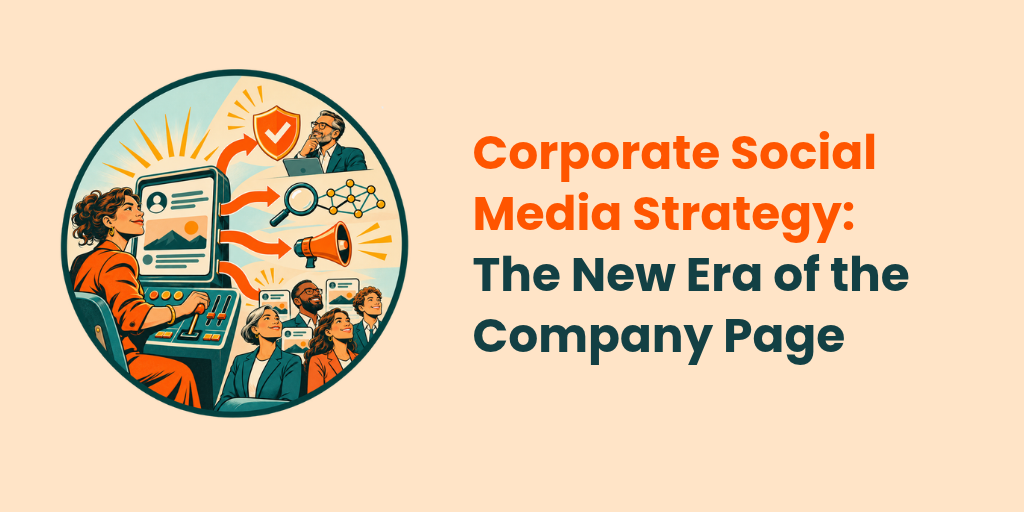
The company page has lost its job as a reach channel but gained four others that are less glamorous and considerably more useful: a verification layer that buyers and AI systems check, a source that generative engines cite, the account your paid budget runs through, and the hub that employee and executive advocacy amplifies.

A corporate social media strategy built around reach in 2027 will keep disappointing you, but if you are looking to boost AI search and buyer preference, the LinkedIn company page still has a major role to play.
What Actually Happened to Company Page Reach
LinkedIn’s feed changed in ways that cost brand accounts more than individual ones, though not for the reason most people assume. The gap between profiles and pages is real but narrower than suggested. Metricool’s LinkedIn study found pages and personal profiles pull roughly the same impressions per post; the difference shows up in engagement, at 1.60% for pages against 2.60% for profiles. You’ll see a widely repeated claim that personal profiles outperform company pages by 561%. Treat that one carefully – according to Metricool, the measured gap is a fraction of that size.
At the same time, AI-generated filler flooded every feed and platforms started deprioritizing content that reads like it was produced by a machine. Buyers changed how they use social channels as well, treating platforms as search surfaces rather than news and update feeds.
What the Company Page Is For in 2027
Executive social media is one of the better examples of Multiplier Marketing at work. The engagement it generates on its own is fine. The more interesting returns show up in the channels around it.
Executive social + PR.
An executive with an established point of view is an easier sell to a journalist than one with no public track record, and reporters do check LinkedIn before agreeing to a briefing. A leader who has been commenting intelligently on a beat for six months is a credible source. Coverage then gets amplified back through the executive’s own channels, with added perspective.
Verification
Before a buying committee takes a meeting, someone checks your company page. So does a journalist before a briefing, a candidate before an interview, and an investor doing early diligence. A page that hasn’t been updated in a year undercuts whatever thought leadership you’ve been building everywhere else, and it makes the brand look like it stopped paying attention.
Citation and discovery
Generative engines pull from social platforms as part of how they describe companies. Your page is one of the few sources about your company that you fully control and that sits outside your own domain. More on this below.
The account your paid budget runs through
Every piece of corporate social media advertising you run is attached to the page. Its follower base, content history, and engagement patterns feed targeting and social proof on the ads themselves, so a neglected page raises the cost of every campaign you run through it.
The amplification hub
Employee and executive social media programs need something to amplify. The page originates content that people with actual reach can share, comment on, and build on. The reach lives in the profiles, even though the page is where most of it starts.
A listening and engagement surface
The brand account is how you participate in conversations about your company that you didn’t start. We’ll come back to this one, because it’s the piece many programs skip and the one that has changed the most.
How Corporate Social Media Influences GEO and AI Search
Social media is a real input into AI answers, but a smaller one than most 2027 trend posts suggest. OtterlyAI’s analysis of 100 million AI citations put social and video domains at roughly 5.5% of citations, with LinkedIn’s share of that slice rising through the first half of 2026.
Reddit’s share of ChatGPT Search citations fell by 86% in four days last August, with no announced cause. You can’t optimize for one engine’s current preferences, because they’ll be different next quarter. What holds up is being consistently present, in your own words, on platforms that get crawled, saying things specific enough to be worth quoting.
That means a few concrete things for the company page:
- Write posts that can stand alone: A post that says “great piece from our CTO, link in comments” gives a model nothing. A post that states the actual argument in three sentences gives it something to extract.
- Define your own terms: If your category has contested vocabulary, your page should be one of the places that defines it. This connects directly to SEO-driven brand messaging: the language on your page should match the language on your site.
- Stay consistent across sources: When your page, your site, and your executives describe the company the same way, models have corroboration. When they don’t, you’ve given the system three different answers to choose from.
For the measurement side, our guide on how to measure web traffic from AI covers the tracking worth setting up, and 5 ways to boost brand visibility in AI search results covers the fundamentals.
Publish LinkedIn Articles, Not Just Posts
Organic posts published directly in the feed are gone in a day or two. LinkedIn Articles get indexed by Google, keep surfacing in LinkedIn search months after publication, and run long enough to make an actual argument.
Which format gets cited depends on the engine. Otterly published the same 60 topics as both articles and posts and found articles took 98% of the citations the campaign earned — almost entirely from Copilot and Perplexity. On ChatGPT the pattern inverts, with posts leading at 66%, and Meltwater’s study of 9.5 million citations found text posts at 72% of cited LinkedIn content against 12% for articles. The useful conclusion is that articles and posts win in different places, so a page doing only one is leaving citations on the table.
For a company page, that makes articles worth the extra effort on anything you’d want quoted back to you: a position on a category debate, a definition of a term your competitors use differently, an explanation of how something actually works. One article a month, broken up into several feed posts afterward, is a more durable asset than ten posts that vanish.
A Corporate Social Media Management Process That Holds Up
The basics of managing a corporate social media account haven’t gotten more complicated, but the order matters. Here’s the workflow we run for B2B clients:
- Identify content. Start from what already exists and what’s already planned: owned content, earned coverage, product news, data you can share, industry developments worth a point of view. The best corporate social calendars are assembled rather than invented, which is also what keeps them sustainable.
- Draft posts. Written for the platform, not pasted from the blog headline. Each post should carry its argument in the text itself, for the reasons above.
- Schedule. Through a management platform (we use Hootsuite for most accounts) or natively, depending on the client and the platform. Native posting sometimes gets better distribution and always costs more time, so it’s worth testing rather than assuming.
- Quality check after posting. Confirm the post rendered correctly, the link preview pulled the right image, tags resolved, and nothing truncated. Scheduled posts fail more often than people expect.
- Engage from the brand account. Monitor where the company is mentioned by employees, customers, partners, analysts, and third parties, then comment and react under the corporate profile. This is the step most programs still skip. It costs almost nothing, it extends the reach of posts you didn’t have to create, and it puts the brand into conversations it would otherwise be absent from.
Given where organic reach now sits, a thoughtful comment on an employee’s post that’s already reaching 9,000 people is frequently worth more than another original post reaching 800. Corporate social media management in 2027 is at least as much about showing up in other people’s threads as publishing in your own.
Corporate Social Media Best Practices for 2027
- Post less, but never stop: Two or three strong posts a week beats daily filler, and consistency matters more than volume for both the algorithm and the humans checking whether you’re still in business.
- Let people carry the reach: Build an employee advocacy habit and an executive program, and treat the page as the supply line. This is the single highest-leverage change most B2B companies can make.
- Write corporate social media guidelines before you need them: Who can speak for the brand, what requires approval, how to handle criticism, what employees can and can’t share. A short, practical document beats a long corporate social media policy nobody reads.
- Keep video human: Short, unpolished, person-on-camera footage outperforms produced brand video on every B2B platform right now, and it costs less.
- Respond to comments within the day: Engagement in the first hours shapes distribution, and an unanswered question on a brand post is worse than no post.
- Don’t automate the voice: Platforms are actively deprioritizing content that reads as machine-generated. Use AI for research, drafting support, and scheduling logistics. Keep a person on the final pass.
- Audit quarterly, not annually: Reach benchmarks, citation patterns, and platform rules are all moving fast enough that an annual review is a year of running on stale assumptions.
When to Use Paid Social Media
With the average company page post drawing around 800 impressions, paid is the main way most enterprise social media programs reach anyone beyond their existing followers.
Paid is the right call for:
- Amplifying content that already proved itself: A post that earned real organic engagement is tested creative. Promoting it is cheaper and lower risk than running something nobody has seen.
- Reaching named accounts: LinkedIn’s firmographic targeting is expensive per click and more precise than anything else available, which makes it the natural partner for account-based advertising.
- Time-bound moments: Launches, funding news, events, and report releases all have windows that organic distribution will miss.
- Recruiting and category education: Both need reach against audiences who don’t follow you yet.
Paid is the wrong call for propping up a page with nothing to say, for buying followers, or for compensating for the absence of an executive and employee program. Spending against weak content gets you a more expensive version of the same problem. The compounding effect shows up when organic, paid, employee advocacy, and executive social all point in the same direction, which is the Multiplier Marketing argument in a nutshell.
How to Measure Corporate Social Media
Reach and follower count are the two metrics most corporate social reports still lead with, and they’re the two that have lost the most meaning. More useful:
- Engagement rate on posts, which tells you whether content lands with the people it does reach
- Share of posts amplified by employees and executives, which is the leading indicator for everything else
- Brand mentions across the web, tracked separately from citations, since a mention with no link still shapes how models describe you
- Referral traffic from AI platforms in GA4, which is small for most B2B companies and growing
- Pipeline influence, through self-reported at
Final Thoughts: The Page Isn’t the Audience Anymore
Corporate social media got measured against the wrong benchmark for about a decade. Pages were never going to out-reach people, and once platforms stopped subsidizing brand distribution, the gap became obvious.
The company page is where your category language lives, where buyers and models go to confirm what you do, where paid campaigns originate, and where the content comes from that your people carry further than any page ever could. None of that shows up in a reach report, which is why the channel keeps getting written off by the people who fund it.
If your corporate social media strategy is still built around a posting calendar and a follower target, let’s talk about what it should look like instead. Firebrand runs corporate social alongside PR, GEO, and paid media so the channels reinforce each other.
Corporate Social Media Strategy FAQs
What is a corporate social media strategy?
A corporate social media strategy is the plan for how a company’s own branded accounts support the business: which platforms the brand maintains, what gets published, who engages on the company’s behalf, how paid distribution is used, and how performance ties back to pipeline and search visibility.
It differs from a social media marketing plan in scope. A marketing plan asks what to post. A strategy asks what the channel is for, which in 2027 means deciding how the page supports verification, AI citation, paid distribution, and employee amplification rather than chasing organic reach the algorithm no longer provides.
Why is corporate social media important for businesses?
The benefits of corporate social media have shifted from reach to credibility and discoverability. Buyers check company pages before meetings, candidates check them before interviews, and journalists check them before briefings. An active, current page confirms the company is real and operating, which sounds trivial until a neglected page costs you a deal.
Beyond verification, the page is a controlled source about your company that lives off your own domain, which matters for how AI systems describe you. It’s also the origin point for paid campaigns and the content supply for employee and executive advocacy. Those jobs don’t show up in an engagement report, which is why so many programs get judged unfairly.
Which platforms should a B2B company prioritize in 2027?
LinkedIn remains the default for B2B, since it concentrates decision-makers more than any alternative and is the most-cited social source in AI search after Reddit and YouTube. X still matters for companies in categories where journalists and analysts follow real-time conversation.
YouTube deserves more attention than most B2B teams give it, because it’s consistently among the top-cited domains in AI answers and because video content has a longer discovery life than feed posts. Reddit is worth monitoring rather than posting into for most B2B brands; its citation weight is high and volatile, and community backlash against corporate accounts is real. Start with two platforms maintained properly rather than five maintained badly.
How does corporate social media affect GEO and AI search?
Social and video domains account for roughly 5.5% of AI citations according to Otterly’s analysis of 100 million citations, with LinkedIn’s share of social citations rising through the first half of 2026. Your company page contributes to the body of content models draw from when describing your business.
Consistency matters more than placement. When your page, your website, and your executives use the same language about what the company does, models have corroborating sources to draw on. When those descriptions conflict, the model picks one, and you don’t get a say in which. Platform citation shares change too quickly to optimize for directly, so the durable play is being present, specific, and consistent rather than chasing whichever source a given engine favors this quarter.
When should a company use paid social instead of organic?
Use paid when the content has already proven itself organically, when you need to reach named accounts rather than existing followers, when a launch or event has a fixed window, or when you’re building awareness in a category that doesn’t know you yet. Corporate social media advertising is best understood as distribution for content that’s already working.
Don’t use paid to compensate for a weak page or a missing employee program. If your organic posts aren’t earning engagement from the small audience they do reach, paid will deliver that same result to more people at a higher cost.
What should corporate social media guidelines include?
Practical guidelines cover who is authorized to post and engage under the brand account, what topics require legal or executive approval, how to respond to criticism and misinformation, escalation paths for anything sensitive, and what employees can share from their own accounts.
Keep it short enough that people read it. Most corporate social media policy documents fail because they’re written as liability shields rather than operating instructions. A two-page version that answers the questions people actually have works better than a twenty-page version nobody opens.
How often should a company page post?
Two to four times per week suits most B2B company pages. Consistency matters more than frequency, both for distribution and for the people checking whether your company is active.
Posting daily rarely improves results and usually degrades quality, since the calendar starts driving the content. Given current reach, a smaller number of strong posts amplified by employees and executives outperforms a higher volume published into a feed where the average company post draws around 800 impressions.
Should corporate social media be managed in-house or by an agency?
The split that works for most programs puts content identification, drafting, scheduling, and quality control with an agency, since the work is continuous, process-driven, and benefits from seeing patterns across accounts. Enterprise social media management also tends to need more consistency than a stretched in-house marketer can sustain alongside other responsibilities.
What can’t be outsourced is subject matter judgment and internal awareness: knowing what’s actually happening in the business, what’s sensitive, and which internal voices are worth amplifying. The arrangements that work best pair an agency running the process with an internal owner supplying context and approvals.
About the Author

Shane Jordan is a San Francisco-based digital marketing pro with a passion for driving brand growth. At Firebrand, Shane focuses on client growth strategies including SEO & Generative Engine Optimization (GEO), PPC, organic & paid social media, Influencer marketing and performance analytics. He writes practical guides on digital marketing topics including SEO Best Practices, PPC Landing Pages, Multiplier Marketing, and Measuring AI Web Traffic.
With a seasoned background and a passion for emerging tech, Shane helps brands navigate the future of marketing. Outside of work, he enjoys coastal hikes with his family and piloting small aircraft.
Follow Shane on LinkedIn or explore more on Firebrand’s startup marketing agency blog.