Most GEO strategies don’t fail because of bad content. They fail because everything is happening in isolation. The SEO team is focused on rankings. The content team is publishing blog posts without thinking of keywords. PR is chasing coverage without understanding which domains are being cited in AI. Social and influencer programs are running with little thought about consistent topical authority.
On paper, it looks like a complete marketing strategy. In reality, it’s fragmented. Siloed efforts and content fragmentation don’t work where AI search engines are assembling answers from patterns across the entire internet. Generative Engine Optimization (GEO) isn’t about winning in one channel. It’s about consistent visibility across many channels, and getting those signals to reinforce each other.
Comprehensive GEO coverage comes when everything connects and operates as a system. That’s when your marketing efforts start to operate less like a collection of tactics, and more like a unified and coordinated system that LLMs clearly see as authoritative sources of information for your audience.
The Shift from Channels to Systems
Traditional SEO trained marketers to think in terms of pages, rankings, and traffic. And that still matters. SEO remains the foundation of discoverability and the starting point for any serious GEO strategy. But generative search has changed the rules.
AI platforms like ChatGPT, Perplexity, and Gemini aren’t just ranking content. They are also synthesizing content from various online sources. They pull from multiple sources and domains, identify patterns, and generate answers based on what appears to be the most consistent and trustworthy information available. That means your brand visibility is determined by how well your entire digital presence aligns.
This is why GEO has quickly become a cross-functional effort. SEO, content marketing, PR, and influencer relations are no longer separate workstreams. They are inputs into the same system.
The 4 Pillars of Comprehensive GEO
To compete in AI-driven search, brands need more than strong execution in one area. They need coordinated coverage across four core pillars. Each pillar reinforces the others, each contributing to how generative engines understand and trust your brand.
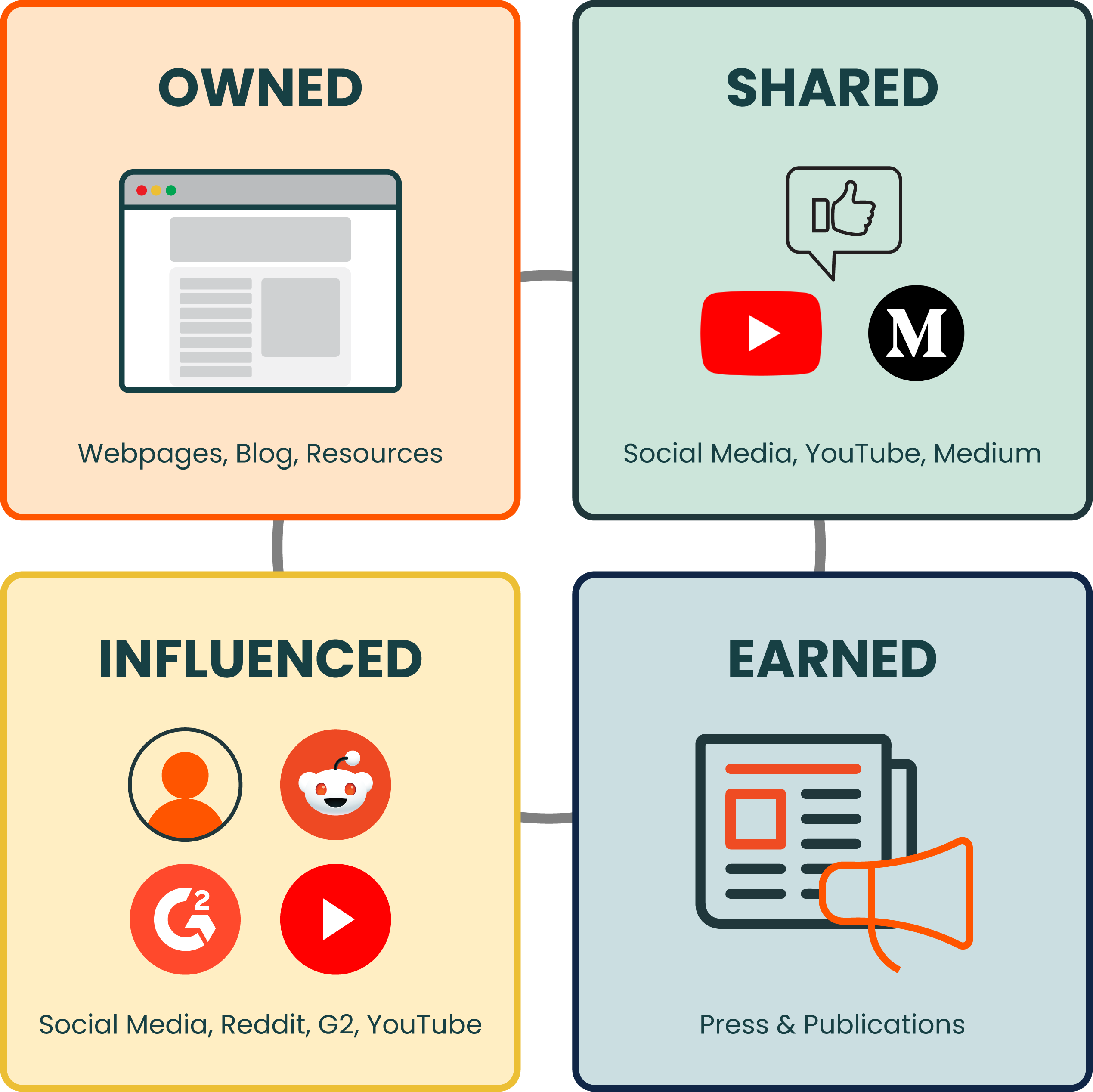
The diagram provides a visual representation of the four pillars connected, including Owned, Shared, Influenced, and Earned. This approach is a slight update to the existing more broad marketing model of owned, earned, and paid media. Each pillar is broken down below.
1. Owned: Your Source of Truth
This is where your SEO strategy lives and your GEO strategy gets its foundation. It’s where you define your category, explain your product, host thorough content about your area of expertise, and answer the core questions your buyers are asking. In a GEO context, on-site content has a bigger job to do. It needs to be structured in a way that generative engines can easily interpret. It needs to be clear, direct, and comprehensive. Website content needs to reflect real expertise, not just keyword targeting.
Strong on-site content doesn’t just rank, it becomes source material. When AI models look for answers, this is where they go to understand what your brand offers.

2. Shared: Extending Your Reach
Channels: LinkedIn, YouTube, Medium, Substack (and similar platforms) – ones you have control over but are not your core website.
Your brand presence doesn’t exist only on your website. Platforms like LinkedIn, YouTube, and Medium have become critical extensions of your content marketing strategy. These channels are not just for distribution, but for visibility in the environments where models are actively learning. AI search tools like Scrunch and Gumshoe consistently show these platforms are being cited by top AI models.
Publishing off-site allows you to reinforce your messaging in multiple contexts, reach new audiences, and create additional surfaces for your expertise to be recognized and referenced. This is where SEO starts to blend with content marketing and social strategy. It’s also where many brands fall short, by treating these channels as promotional outlets instead of strategic assets.
In GEO, repetition across trusted platforms isn’t creating noise. It’s creating signals.
3. Influenced & Community: Borrowed Trust
Channels: Social media, Reddit, G2, YouTube creators, industry voices
One of the biggest differences between SEO and GEO is how much weight is placed on what others say about you. Generative engines don’t just rely on brand-owned content. They look at conversations happening across communities, review platforms, and social channels to understand reputation, sentiment, and relevance.
This is where influencer marketing and community engagement become critical to GEO. Mentions on Reddit threads, discussions on LinkedIn, reviews on platforms like G2, and commentary from industry experts all contribute to how your brand is perceived. These signals help shape the kinds of queries where your brand shows up, especially “best of,” “alternatives,” and recommendation-based prompts. Each mention on a third-party site or influencers social media is like a vote of confidence that models use to decide whether to mention your brand or not.
In many cases, this is the difference between being visible and being overlooked.
4. Earned Media: Authority at Scale
Channels: Press, publications, analyst coverage
Public relations has always been about credibility. In GEO, it becomes a multiplier.
Coverage in reputable publications, thought leadership placements, and analyst mentions act as external validation that generative engines trust. These sources carry weight because they are independent, curated, and widely recognized.
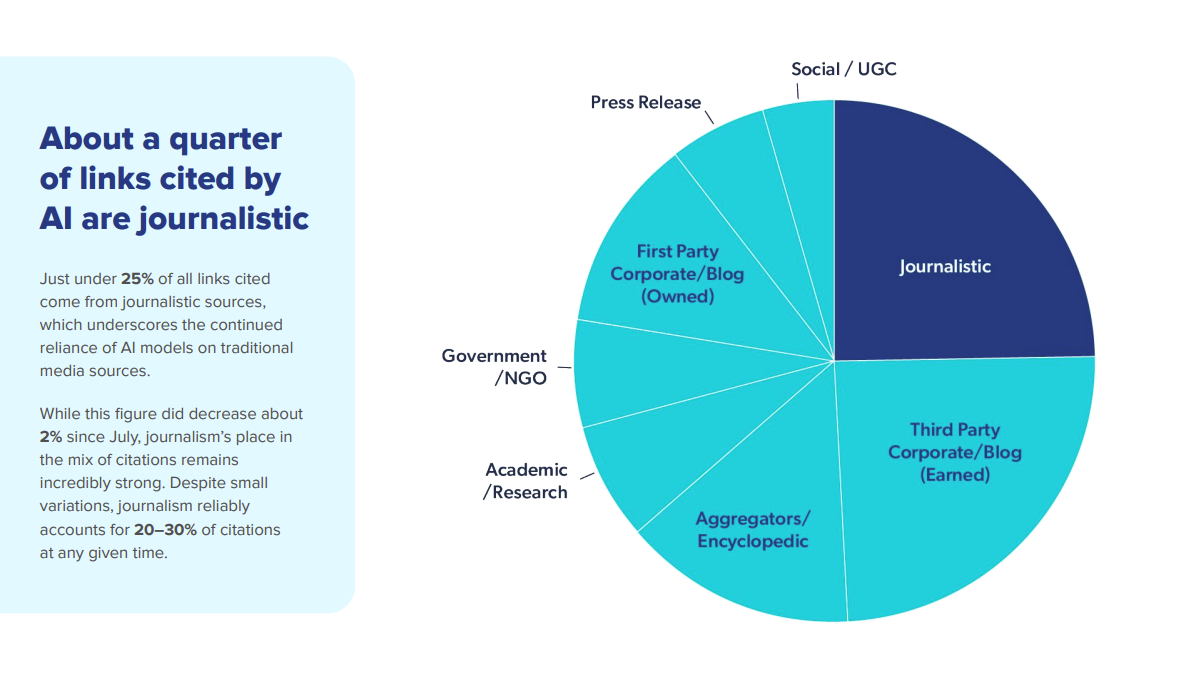
When your brand consistently appears in high-authority media, it strengthens your position across both traditional search and AI-generated results. It increases the likelihood that your brand will be cited, referenced, or included in synthesized answers. A study by MuckRack found that Journalistic sources made up 25% of all sources cited by AI.

This is where SEO, PR, and GEO fully converge. Because at this level, visibility isn’t just about what you publish, it’s about who else wants to share your news with their community.
From Disconnected Efforts to a Unified GEO Strategy
When the four pillars of comprehensive GEO are aligned, something changes. Your website defines a clear narrative. Your off-site content reinforces it across multiple platforms. Influencers and communities echo it in real conversations, and earned media validates it at scale.
Now, instead of scattered signals, you have a unified presence. Instead of competing for rankings, you’re influencing answers. Instead of hoping to be discovered, you’re becoming part of the default set of brands that generative engines recognize and recommend.
That’s the difference between operating as individual parts, and operating as a unified system.
Increasing Brand Growth Through Comprehensive GEO
GEO isn’t an entirely new channel after all. It’s a new way of thinking about how all your existing channels work together. SEO is still foundational. Content marketing is still critical. Earned media and influencer marketing are more important than ever. But none of them reach their full potential in isolation.
What GEO is really telling us is that winning in AI search isn’t a specialist’s game. It’s the reward for getting integrated marketing right. The brands that show up in AI-generated answers aren’t gaming a new algorithm. They’re the ones who’ve built enough credibility, coverage, and consistency across channels that AI systems have no choice but to surface them.
That has real implications for how marketing leaders think about spend. As zero-click behavior accelerates, the value of brand visibility shifts upstream. If you’re not present in the AI-generated results shaping your buyers’ thinking, you may never enter their consideration set at all. This is the wrong moment to pull back. It’s the moment to invest in a strategy coherent enough to be seen.
The brands that win in AI search won’t be the ones doing more. They’ll be the ones doing it under a unified system.
Comprehensive GEO FAQs
What is comprehensive GEO?
Comprehensive GEO refers to a fully integrated approach to GEO (Generative Engine Optimization) that combines SEO, content, PR, influencer marketing, and distribution. Instead of relying on a single channel, comprehensive GEO ensures your brand is consistently represented across owned, off-site, influencer, and earned media sources, improving visibility in AI-generated search results.
What are generative engine optimization strategies?
Generative engine optimization strategies are tactics designed to increase your brand’s visibility in AI-powered search platforms like ChatGPT, Google AI Overviews, and Perplexity. These strategies include creating prompt-aligned content, building authority through PR and earned media, engaging influencers and communities, and reinforcing messaging across multiple platforms to improve inclusion in generated answers.
How is GEO different from traditional SEO?
SEO focuses on ranking webpages in search engine results, while GEO focuses on being included in AI-generated answers. A strong SEO foundation is still essential, but GEO expands beyond your website to include third-party platforms, influencer mentions, and earned media signals that help generative engines understand and trust your brand.
Can SEO and GEO strategies work together for better results?
Yes, SEO and GEO strategies work best when combined. SEO provides the structured, high-quality content that serves as a foundation, while GEO amplifies that content across additional channels like PR, influencer marketing, and social platforms. Together, they create stronger, more consistent signals that improve both rankings and AI-driven visibility.
What are comprehensive GEO and SEO solutions for better visibility?
Comprehensive GEO and SEO solutions for better visibility integrate on-site optimization with off-site distribution, influencer engagement, and earned media. This approach ensures your brand appears consistently across search engines and AI platforms, increasing the likelihood of being cited, recommended, and included in synthesized answers.
Why is influencer and earned media important for GEO?
Influencer and earned media play a critical role in GEO because they provide third-party validation. Generative engines analyze what others say about your brand across platforms like LinkedIn, Reddit, G2, and industry publications. These external signals help shape trust, improve credibility, and increase your chances of appearing in recommendation and comparison-based queries.
About the Author

Shane Jordan is a San Francisco-based digital marketing pro with a passion for driving brand growth. At Firebrand, Shane focuses on client growth strategies including SEO & Generative Engine Optimization (GEO), PPC, organic & paid social media, Influencer marketing and performance analytics. He writes practical guides on digital marketing topics including SEO Best Practices, PPC Landing Pages, Multiplier Marketing, and Measuring AI Web Traffic.
With a seasoned background and a passion for emerging tech, Shane helps brands navigate the future of marketing. Outside of work, he enjoys coastal hikes with his family and piloting small aircraft.
Follow Shane on LinkedIn or explore more on Firebrand’s startup marketing agency blog.