There is a real argument happening across LinkedIn, Reddit, and inside marketing teams right now about whether Generative Engine Optimization is a distinct discipline or just SEO with a new name.
The practitioners who say GEO is mostly rebranded SEO are not wrong: the overlap with established fundamentals like content depth, topical authority, E-E-A-T, and structured data is substantial. The practitioners who say something genuinely new is happening are also not wrong: AI search introduces different retrieval mechanics, different platform behaviors, and a measurement environment that has no real equivalent in traditional search.
Where we land: SEO is the foundation for GEO. You cannot skip the foundation and expect AI visibility to follow. But the tactics that work specifically for AI retrieval (structured answer content, multi-channel authority building, earned media) do diverge from pure SEO in meaningful ways. And measuring success is a different problem entirely.
SEO Is the Foundation and the Case for It Has Never Been Stronger
One risk of the current GEO conversation is that it creates uncertainty about SEO investment at a moment when the case for SEO is stronger than it has been in years.
Traditional organic search remains the highest-volume discovery channel available to B2B marketers. The “Do A, Get B” measurement model is intact. Keyword rankings, organic traffic, assisted conversions, and pipeline influence can all be tracked with a level of confidence and specificity that AI search cannot yet match. For teams defending budget, that measurability matters a lot.
There is also a data point that gets buried in the GEO debate: approximately 92% of AI Overview citations come from domains that already appear in the traditional search top 10 for a given query. The brands showing up in AI-generated answers are, in most cases, the brands that have already built serious topical authority through SEO. GEO visibility is not separate from SEO performance – it is largely a downstream consequence of it. Invest in SEO, and GEO visibility tends to follow.
Around 58.5% of Google searches now end without a click, and that figure is higher for queries that trigger AI Overviews. But the evidence does not support the conclusion that SEO value is therefore declining. Pages cited in AI Overviews receive approximately 35% more organic clicks and 91% more paid clicks than non-cited competitors. Measuring SEO in an AI-powered search environment means accounting for those downstream effects, not just direct click attribution. We went deeper on this in our post on organic search visibility as the new north star for B2B marketers.
SEO is not something you graduate from on the way to GEO. It is what makes GEO possible.
Where GEO Diverges: Different Retrieval, Different Tactics, Different Measurement
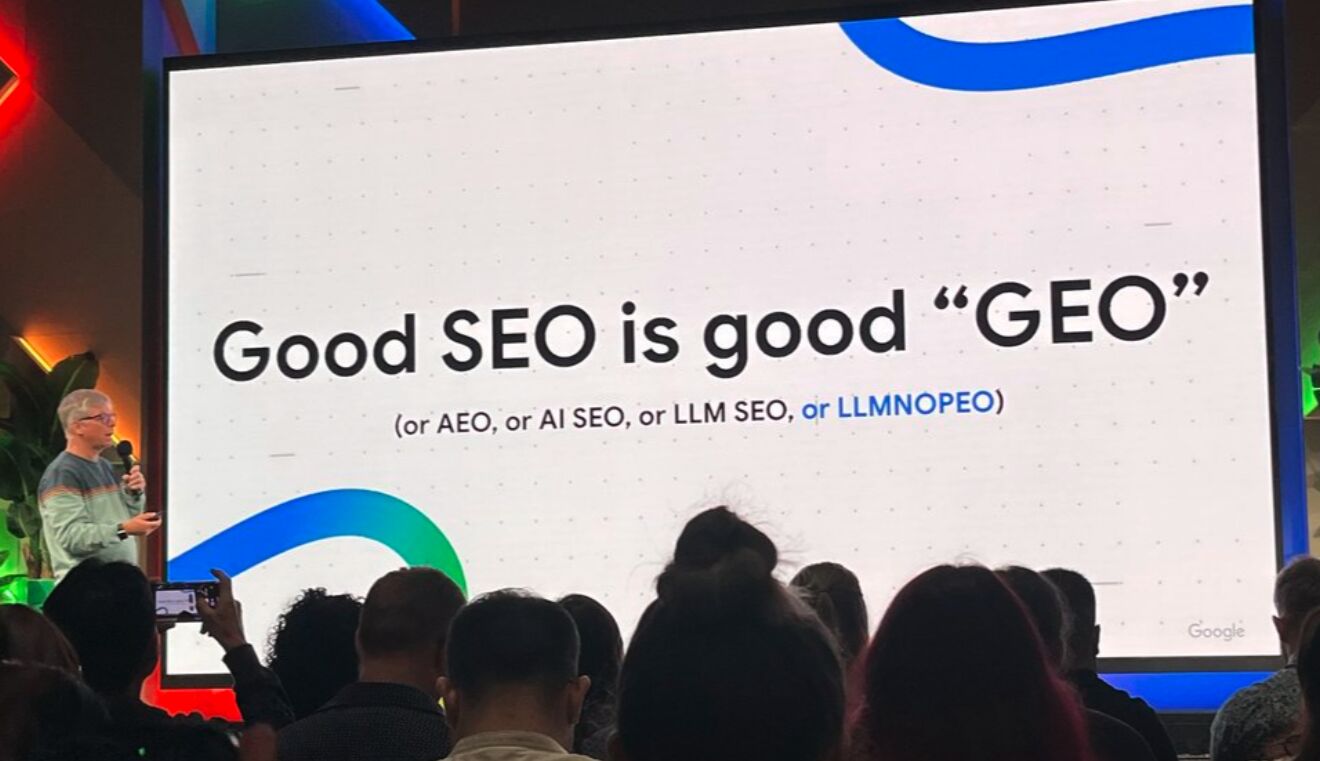
That said, something has changed. And the people making the most credible case for it aren’t the GEO vendors – they’re practitioners like Jean-Christophe Chouinard, Senior SEO Strategist at Tripadvisor, who responded directly to the Danny Sullivan “good SEO is good GEO” position with a detailed LinkedIn post that acknowledged the SEO foundation while pushing back on the “do the same as you always did” interpretation.
- Sites outside the top 100 for a given query are now appearing in AI-generated results with a frequency that would not have been possible in standard search rankings two years ago. The pool of sources AI systems draw from is not the same as the ranking pool Google surfaces to users.
- There is significantly more volatility in AI Mode and AI Overviews than in standard search results. The optimization question shifts — it is no longer only about which queries you rank for, but when you appear for a given query.
- AI Mode introduces a personalization layer with no direct equivalent in traditional SEO, which changes how you need to think about testing and interpretation.
- Most consequentially, access to performance data has been significantly reduced. AI Mode and AI Overviews are bundled with search in ways that limit what surfaces in Search Console and other standard reporting tools. The data practitioners have relied on for optimization decisions is no longer fully available.
The retrieval problem is structurally different
Traditional SEO has a clear feedback loop: you publish content, Google crawls and ranks it, you can see what drives clicks, and what converts.
AI search works differently. Large language models retrieve content through a process called Retrieval Augmented Generation (RAG), where the system pulls relevant chunks of content from an index and synthesizes a response. The unit of retrieval is not a page — it is a passage. A well-structured paragraph that directly answers a specific question can be extracted and cited even if the broader page does not rank prominently for that query. This is why FAQ content, structured-answer formats, and self-contained explanations perform differently in AI search than they do in traditional rankings. It also means that content structure matters in ways it did not before. A wall of prose optimized for keyword density and topical breadth may rank well in Google while being largely invisible to AI retrieval. Content that is chunked into direct, answerable sections — with clear context, specific claims, and attribution signals — is more likely to be selected as a source in a synthesized response.
Measurement is a genuinely different problem
This is where the GEO-is-just-SEO argument breaks down:not the tactics t, but the measurement infrastructure.
With traditional SEO, you have first-party data. Google Search Console tells you which queries triggered impressions, which drove clicks, and what your average position was. Bing Webmaster Tools does the same. You can tie organic visibility to pipeline with reasonable confidence.
AI platforms give you none of that. ChatGPT, Perplexity, Claude, and Gemini do not expose query data. There is no GEO equivalent of Search Console. You cannot see how often your content is being retrieved, which prompts trigger citations, or how your visibility has shifted week over week.
The best available method is synthetic prompting: running a defined set of representative queries through AI platforms and tracking whether your brand is cited, how often, and in what context. Tools like Scrunch are building infrastructure around this,but it is a proxy measurement, not a direct one. The prompts you choose shape the results, and there is no way to know how representative your prompt set is of actual user behavior.
This does not make GEO measurement worthless. Citation frequency, share of voice against competitors, and sentiment of AI mentions are all meaningful signals. But any team building a GEO reporting framework needs to be clear internally about what synthetic data can and cannot tell you – and resist the pressure to present proxy metrics as if they were direct performance data.
What Are Effective Strategies for GEO? Unique Tactics With Demonstrated Impact
Setting aside definitional questions, there are specific tactics with demonstrated impact on AI search visibility. Many will be familiar to teams already executing a serious SEO program, which reinforces the foundation-first argument. The ones that are genuinely new or require a different approach are worth identifying specifically when building out what are effective strategies for GEO in a B2B context. Below are some established GEO best practices.
Structured Data and Schema Markup
Schema markup helps AI systems interpret the structure and context of content more reliably. While its direct influence on LLM responses is still subject to debate — given that HTML is often stripped during model training — it remains a meaningful signal for Google AI Overviews and other search-integrated AI systems. For more detail, see our guide on Technical GEO and AI search visibility signals.
FAQ Pages and Structured Answer Content
AI systems retrieve individual content sections rather than full articles. Content structured as direct, self-contained answers — FAQ sections, numbered lists, and clearly defined explanations — is more likely to be extracted and incorporated into generated responses. For more detail, see our post on the importance of FAQ pages for SEO and GEO.
Multi-Channel Authority Building on Reddit and YouTube
Analysis of LLM citation behavior in 2025 found that Reddit, LinkedIn, and YouTube were among the most frequently referenced domains across major AI platforms. These platforms carry weight in AI retrieval because they host authentic, unsponsored discussion that AI systems treat as independent validation. For B2B brands, participation in relevant Reddit communities, educational content on YouTube, and consistent LinkedIn publishing are direct inputs into AI search visibility. We covered the strategic approach to Reddit in more detail in our post on leveraging Reddit for B2B competitive advantage.
Third-Party Review Platforms
Platforms such as G2 and Quora are frequently cited by AI systems when responding to comparison and recommendation queries — the types of high-intent prompts that B2B buyers use when evaluating solutions. A well-maintained presence on review platforms is increasingly a GEO asset as much as it is a sales enablement tool.
Earned Media and Press Coverage
Research from Muck Rack’s Generative Pulse, which analyzed over one million AI-cited links, found that journalistic sources account for approximately 27 percent of all sources cited by AI platforms, rising to 49 percent for time-sensitive queries. Coverage in credible publications functions as an authority signal that AI systems weigh meaningfully. This is where PR activity and GEO strategy converge most directly, and one of the reasons that an integrated approach produces stronger results than treating GEO as a standalone SEO sub-discipline.
Integrating GEO and SEO: The Four Pillars Framework
The most practical resolution to the GEO vs SEO debate is not definitional but structural. Rather than deciding whether GEO is SEO, the more useful question is how to organize your search visibility strategy to address both traditional and AI-driven discovery without treating them as competing priorities. The GEO and SEO integration question is about how to get both working together as a system.
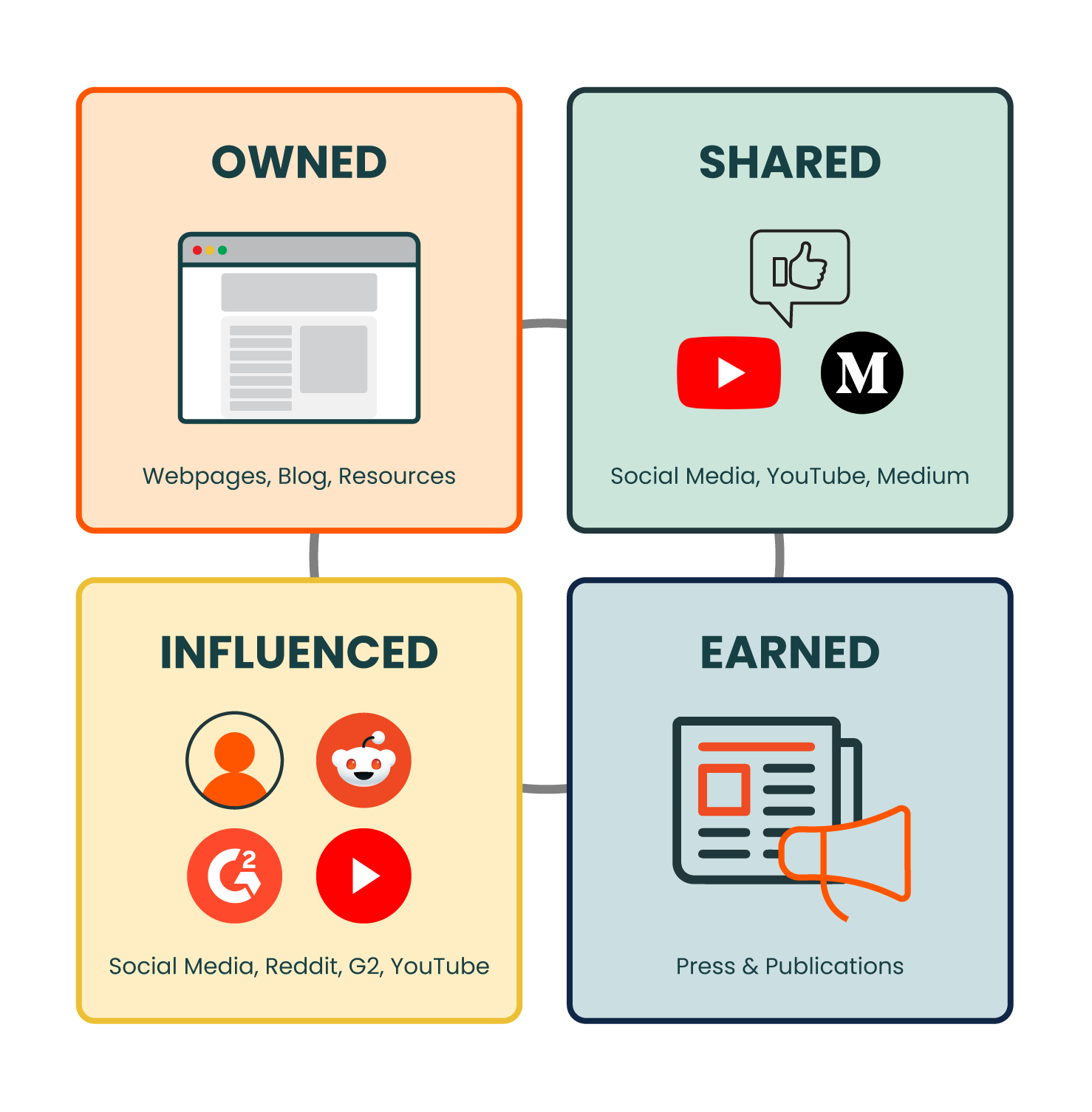
Our Four Pillars of Comprehensive GEO provides a useful framework for this. It organizes GEO strategy across four interconnected areas:
- Owned: Your website and on-site content — the source of truth that defines your category positioning, answers buyer questions, and provides the structured, authoritative content that both traditional search engines and AI systems rely on. This is where SEO investment lives and where the most measurable ROI is generated.
- Shared: Platforms you publish to but do not own — LinkedIn, YouTube, Medium, and similar channels. These extend your content into environments where AI systems are actively retrieving information and create additional surfaces for your expertise to be recognized.
- Influenced: Third-party communities including Reddit, G2, and industry forums. AI systems treat consistent, authentic presence in these environments as independent validation. Mentions and discussions here contribute to how AI platforms assess brand credibility and relevance.
- Earned: Press coverage, analyst mentions, and thought leadership placements in credible publications. These carry significant weight in AI citation behavior and represent the point at which SEO, PR, and GEO strategy most directly converge.
The key design principle of this framework is that SEO is the foundational layer of the Owned pillar that everything else depends on. Without a strong, authoritative owned content presence, the other three pillars have less to amplify and less to point back to. The framework does not ask teams to choose between GEO and SEO, it asks them to build the kind of integrated, multi-channel presence that makes both more effective.
Where Does This Leave B2B Marketing Teams?
The most defensible position is to treat SEO as the non-negotiable foundation. Topical authority, technical health, and content depth generate demonstrable organic performance and, as the 92% citation data shows, are the same investments that drive AI search visibility. You are not choosing between them.
From that foundation, layering in the GEO tactics with the strongest evidence base will provide measurable gains in AI visibility but requires a more integrated and deliberate approach to how existing content, paid, PR, and SEO investments are coordinated. If your content team is already producing strong owned content, your PR team is already earning coverage in credible publications, and your SEO program is already building topical authority, you are doing a lot of what GEO requires. The question is whether those efforts are structured in a way that AI retrieval systems can actually use.
Be honest with stakeholders about what synthetic prompting can and cannot show. Citation frequency and competitive share of voice in AI results are meaningful signals worth tracking. They are not a substitute for first-party performance data, and presenting them as such will create credibility problems when the numbers get scrutinized. Build the reporting framework, track the proxies, but frame them accurately.
The brands that will be most visible in AI-generated results over the next two to three years are, in most cases, the ones building the strongest SEO foundations today. That has not changed. What has changed is that those foundations now need to extend across more channels and more content surfaces than they did in a purely traditional search environment. The teams that understand both the continuity and the genuine differences are the ones that will compound visibility in whatever search environment comes next.
Expert Support to Help You With GEO and SEO
Firebrand’s expert growth marketing team can help you implement and optimize the foundations that support visibility in both traditional and AI-powered search environments. From technical site audits and content creation to structured data and schema implementation, our team provides full-scale B2B SEO and GEO services. Simply reach out for more information based on your business-specific needs. We’re here to help you strengthen your site’s organic and AI search visibility, and support your broader marketing goals.
About the Author

Arman Khayyat is a Bay Area–based senior digital marketing leader and Account Supervisor at Firebrand, where he helps B2B startups and scaleups accelerate growth through performance-driven programs. He leads client programs across PPC, SEO, and marketing analytics—helping high-growth startups and enterprise tech brands scale efficiently. His expertise spans everything from paid search architecture and technical SEO audits to funnel analytics and conversion optimization.
Prior to joining Firebrand, Arman held digital marketing leadership roles at B2B technology firms and agencies, bringing over a decade of experience in growth marketing and performance media. Arman frequently writes about B2B lead generation, search strategy, and the evolving role of LLMs and Generative Engine Optimization (GEO) in discoverability. Passionate about the evolving search landscape, he’s currently exploring the impact of LLMs and Generative Engine Optimization (GEO) on organic discoverability.
Outside of work, you’ll find him experimenting with AI tools, perfecting his espresso technique, or watching is favorite sports teams.
Follow Arman on LinkedIn or explore more on Firebrand’s blog.