Today’s modern B2B buyers are increasingly starting outside of brand-controlled channels. As AI search experiences like Google AI Overviews and LLM-powered platforms become more widely adopted, buyers are able to gather information, compare vendors, and form initial opinions without ever visiting a company’s website.
This is shifting where the early stages of the B2B marketing funnel actually take place. Instead of beginning with traditional entry points like organic search results or marketing content, B2B buyers are often starting with AI-generated summaries and third-party discussions that synthesize information from across the web.
As a result, the conventional model of the B2B funnel where awareness and consideration are driven by owned channels or brand-influenced is becoming less accurate. A significant portion of B2B buyer journey research now happens in environments that are not directly visible in analytics and are not directly controlled by marketing teams.
This creates a gap in how many teams think about funnel performance. While metrics still suggest that journeys begin with a website visit or search click, much of the decision-making context has already been established before a website visit has even occurred. As AI search and community-driven content continue to shape how information is consumed, understanding and influencing these upstream touchpoints is becoming a necessary part of B2B marketing strategy.
Your Analytics Are Misconstruing Where the B2B Buying Journey Begins
Analytics platforms still present the modern B2B buyer journey as if it begins at the first measurable interaction — typically a search click, ad engagement, or direct visit. This creates a clean and structured view of funnel entry points, where channels like organic search, paid media, and direct traffic appear to drive initial discovery.
However, this framing reflects a limitation in measurement rather than an accurate representation of behavior.
What’s missing is everything that happens before a user becomes visible for visit attribution. Increasingly, that upstream activity includes AI-driven queries that help define the problem space, community discussions that surface real user sentiment, and internal conversations where recommendations are shared across teams. Much of the B2B buying process has already been shown to occur independently before vendor interaction.
By the time a user enters the funnel in a measurable way, they have often already:
- developed a working understanding of the category
- identified a subset of relevant solutions
- formed early impressions of specific vendors
Your analytics aren’t wrong, but they are incomplete. They show where the journey becomes observable, but not where it actually begins in today’s B2B customer journey.
Users arriving on a site are typically looking to verify what they have already learned. They are assessing whether the product aligns with their expectations, whether the claims are credible, and whether the positioning matches what they have seen elsewhere.
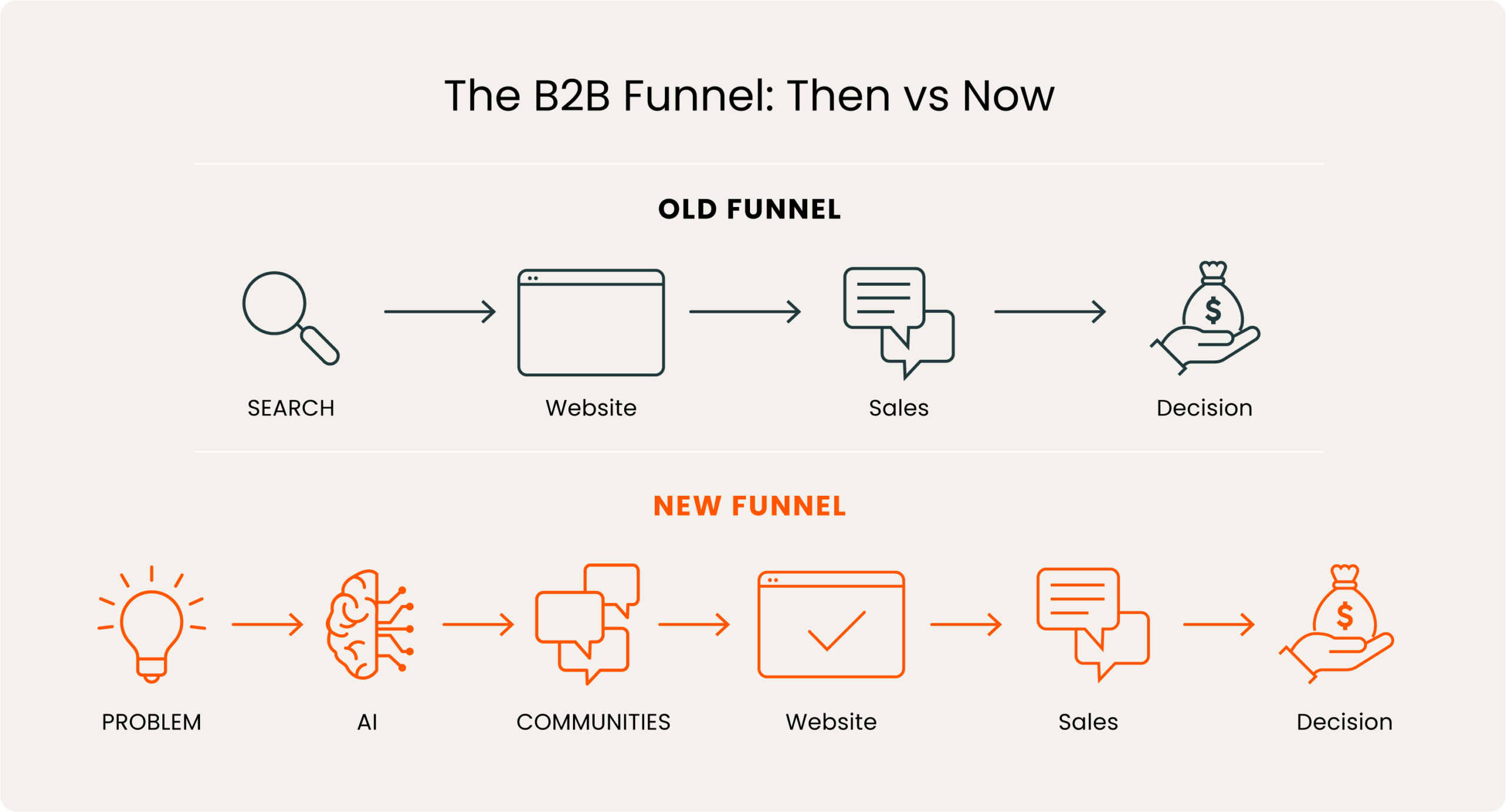
The conventional B2B funnel assumes a linear progression from awareness to consideration to decision, with each stage influenced by channels owned or directly controlled by the brand. This model was built in an environment where traditional search engines acted as the primary discovery layer, websites served as the primary source of information, and brands had a relatively high degree of control over what buyers saw and learned. That environment has changed.
Discovery is now fragmented across platforms, and information is often synthesized before it is consumed. Rather than navigating individual sources, buyers are increasingly presented with consolidated views of a category, shaped by AI systems and third-party content. These shifts align with broader changes in modern B2B buying behavior.
This shifts the role of the website in a meaningful way. It is no longer the starting point for awareness, it is a checkpoint against an existing mental and operational model.
AI Is Becoming the First Touchpoint in B2B Research
AI assisted B2B journeys are increasingly growing where AI is acting as the initial layer of research. Instead of opening multiple tabs and comparing sources, users can ask a single question and receive a synthesized response that consolidates information from across the web.
This changes not only how information is accessed, but how it is structured.
AI systems do not simply retrieve content, they interpret it. They determine how a problem is framed, which solution categories are relevant, and which vendors are included in the response. This shift toward synthesized, answer-first search is reflected in how platforms like Google are evolving search experiences.
This layer often precedes any direct interaction with a brand. B2B buyers can establish a working understanding of a category without visiting a website or engaging with traditional search results. As a result, inclusion within AI-generated responses becomes an early point of influence, even if it does not result in a click.
At the same time, this layer is inherently selective. AI systems retrieve and synthesize a limited set of sources, which means that not all content is surfaced, putting even previously considered “high quality content” at risk of losing visibility.
Visibility, in this context, depends on more than ranking. It depends on whether your content is retrieved and incorporated into AI answers itself, and if you are not investing in understanding how to get your content and expertise mentioned and cited (GEO), then you are losing out on potential business opportunities.
Communities and Peer Content Shape Trust Faster Than Brands Do
After an initial understanding is established in the B2B buying journey, buyers move into validation. This stage increasingly takes place in environments that prioritize unfiltered perspectives over brand-controlled messaging, such as Reddit, private communities, and peer networks.
These environments provide a different type of signal, one grounded in direct experience rather than curated positioning. Modern B2B buyers use them to assess how products perform in practice, where they fall short, and how they compare to alternatives from the perspective of actual users. Trust in peer-driven content continues to outperform brand messaging in many contexts.
The insights gathered here tend to be specific and experience-driven:
- where a product breaks down
- what types of companies it actually works for
- how it compares to competitors in real use cases
By the time someone reaches a company’s website, they are not approaching it without context. They arrive with:
- a shortlist already in mind
- a set of expectations about each option
- a narrative that has been shaped externally
At that point, the website is no longer introducing the product, but rather being evaluated against what the buyer already believes.
B2B Customer Journey Example: Real Life Look at Modern Buyer Behavior
To make this more concrete, it helps to look at how a typical B2B buyer evaluates a product or service today.
Consider a team looking for a new marketing automation platform.
The process does not typically begin with vendor websites. It begins with a need, often driven by limitations in an existing tool, changes in internal processes, or new business requirements. At this stage, the focus is not on comparing vendors. It is on defining the problem and understanding what type of solution is required.
Step 1: Defining the Problem
Before evaluating vendors, buyers are usually trying to establish a clear view of the problem space.
This includes questions such as:
- What exactly are we trying to solve?
- Is a new platform necessary, or can the current one be extended?
- What type of solution is most relevant for our use case?
- Which capabilities are critical versus optional?
This stage is foundational but often underemphasized.
The way the problem is defined directly influences which categories are explored, which features are prioritized, and which vendors are ultimately considered. In practice, this is where the boundaries of the decision are set.
Step 2: AI Creates an Initial View of the Market
Once the problem is more clearly defined, B2B buyers increasingly turn to AI-driven search to orient themselves within the category.
They ask questions such as:
- “What are the best marketing automation tools for B2B?”
- “How does HubSpot compare to Marketo or Pardot?”
- “What should I look for in a marketing automation platform?”
The response is not a list of links but rather a synthesized answer.
This matters because the answer does more than present information. It establishes an initial structure for how the category is understood. It introduces a set of vendors, frames key differences, and highlights evaluation criteria.
At this stage, a shortlist often begins to take shape, not through direct interaction with vendors, but through a consolidated view of the market.
Step 3: Community-Driven Validation
After establishing an initial understanding, buyers typically look for third-party (neutral) validation.
This step is less about learning and more about confirming whether the initial framing aligns with real-world experience.
Common behaviors include:
- searching Reddit for product comparisons
- reviewing discussions in Slack groups or communities
- asking peers for direct feedback
This layer provides a different type of signal.
Rather than structured comparisons, it surfaces patterns based on usage:
- where products perform well
- where they introduce friction
- how they compare in specific contexts
At the end of this stage, the shortlist is often more defined by perceived credibility and consistency across independent sources.
Step 4: Website as Confirmation
Only after these stages do buyers typically engage with vendor websites in a more focused way.
At this point, they are not exploring the category. They are validating specific options.
The evaluation shifts toward questions such as:
- Does this positioning align with what I have already learned?
- Are the claims supported by clear evidence?
- Is there enough detail to confirm this fits our use case?
The role of the website is therefore different than in traditional funnel models. It is no longer introducing the product for the first time, but instead now confirming and expanding upon, or in some cases contradicting the narrative that has already been formed.
Step 5: Sales as Execution
By the time a buyer engages with sales, the B2B purchase decision process is already well underway.
Buyers typically enter conversations with:
- a defined shortlist
- specific questions
- pre-formed opinions about each option
This changes the function of sales interactions. Rather than guiding early-stage discovery, sales is focused on clarifying details, addressing objections, and supporting final decision-making. The narrative has largely been established before the conversation begins.
The Key Takeaway
Across this modern B2B buyer journey, the structure of the journey becomes clear.
- The problem is defined before vendor research begins
- AI establishes an initial view of the market
- communities validate and refine that view
- the website confirms alignment
- sales supports execution
Much of this occurs before any meaningful interaction appears in analytics.
That is the shift. The B2B marketing funnel still exists, but its starting point is earlier, more distributed, and less visible than traditional models suggest.
What Smart B2B Teams Need to Do Differently Now
As the B2B funnel expands upstream, leading teams are beginning to adjust how they define and measure visibility and thus brand awareness. The shift is not away from traditional channels, but beyond them. Search, paid media, and owned content still matter, but they are no longer sufficient on their own to shape how buyers understand a category or evaluate options.
Instead of focusing exclusively on properties they control, these teams are prioritizing presence across the broader ecosystem where buyers form opinions. This requires a more distributed approach to visibility — one that accounts for how information is surfaced, interpreted, and reinforced across multiple environments, reflecting broader shifts toward distributed discovery in search and content ecosystems.
In practice, this includes a combination of efforts:
- Planning and creating content that positions your brand as genuinely useful in the space in which you operate, don’t just tout your product features constantly, but rather show how your product solves a problem that is otherwise difficult to solve
- structuring content so it can be retrieved, interpreted, and reused within AI-generated responses
- building visibility and authority in third-party environments where buyers validate decisions and share experiences with a far reaching content syndication strategy and PR program
- reinforcing brand signals across channels to improve recognition and consistency across touchpoints
These are not isolated tactics. They reflect a broader shift in how discovery works.
As a result, performance is no longer defined solely by traffic or conversion metrics. It increasingly depends on whether a brand is present within the environments that influence how the category is understood in the first place. This has undoubtedly made brand awareness tactics and measurement more important than ever.
This introduces a practical constraint. The earliest and most influential stages of the B2B funnel now occur in places that are not directly editable by the brand, increasing the importance of a multi-channel approach utilizing channels beyond owned, such as earned, and influenced – especially if you want to show up more often in AI search platforms.
Expert Support to Help You Navigate the Modern B2B Buyer Journey
Firebrand’s expert growth team can help you adapt your marketing strategy to align with how modern B2B buyers actually research and make decisions. From structuring content for AI-generated search experiences to improving visibility across third-party environments and strengthening your presence throughout the buyer journey, our team provides full-scale B2B marketing services designed to ensure your brand is positioned effectively across the full spectrum of discovery. Simply reach out for more information based on your business-specific needs. We’re here to help you expand your visibility beyond traditional channels, influence early-stage decision-making, and support your broader marketing and growth objectives.
About the Author

Arman Khayyat is a Bay Area–based senior digital marketing leader and Account Supervisor at Firebrand, where he helps B2B startups and scaleups accelerate growth through performance-driven programs. He leads client programs across PPC, SEO, and marketing analytics—helping high-growth startups and enterprise tech brands scale efficiently. His expertise spans everything from paid search architecture and technical SEO audits to funnel analytics and conversion optimization.
Prior to joining Firebrand, Arman held digital marketing leadership roles at B2B technology firms and agencies, bringing over a decade of experience in growth marketing and performance media. Arman frequently writes about B2B lead generation, search strategy, and the evolving role of LLMs and Generative Engine Optimization (GEO) in discoverability. Passionate about the evolving search landscape, he’s currently exploring the impact of LLMs and Generative Engine Optimization (GEO) on organic discoverability.
Outside of work, you’ll find him experimenting with AI tools, perfecting his espresso technique, or watching is favorite sports teams.
Follow Arman on LinkedIn or explore more on Firebrand’s blog.