
Public Relations
There’s a persistent myth in B2B tech that PR is the soft bit of marketing. The part with the press releases and the vague metrics. You do a bit of PR, you hope for some coverage, you forward the link to your board, and the job is done.
That version of public relations has no place in modern marketing. What replaced it is sharper, more measurable, and harder to deliver. Buyers now form opinions about you long before they ever hit your site, and LLMs are citing articles and analyst reports about you instead of your landing page. Throw in the reality that one unflattering Hacker News thread can tank a funding round, and PR has quietly become one of the highest-leverage disciplines in B2B tech marketing.
Most companies still underinvest in public relations. Which is odd, given the math.
This guide covers what public relations actually is in 2026, how modern PR strategy works, the disciplines that sit within it, how to measure it without kidding yourself, and when to bring in a public relations agency versus building it in-house. It’s written for marketers and founders at B2B tech companies, the people for whom a Fortune feature or a Wall Street Journal mention can shift the arc of a business.
What is Public Relations?
Public relations is the strategic process of building and protecting the reputation of an organization through its relationships with the people who matter to it. What it means in practice is this: PR is how a company gets understood on purpose.
Those “people who matter” are stakeholders, and they’re broader than most first-time founders assume. Customers and prospects are the obvious ones. But the list also includes journalists, industry analysts, investors, partners, regulators, employees, potential employees, academics, and in consumer-adjacent categories, the general public. Each group has a different relationship with the company, consumes different sources, and responds to different messages. The craft of PR is matching the right narrative to the right audience, and doing it at the moment they’re actually paying attention.
The thing most people associate with PR, a company getting written about in the press, is technically called earned media. It’s one discipline within the field rather than the entirety of it. Earned media means coverage a brand didn’t pay for and didn’t publish itself. It’s “earned” because someone with editorial independence decided the story was worth telling. That independence is what makes it powerful. A quote about your product in TechCrunch carries a weight the same quote on your blog simply cannot, because a reporter chose to include it. Third-party validation conveys credibility.
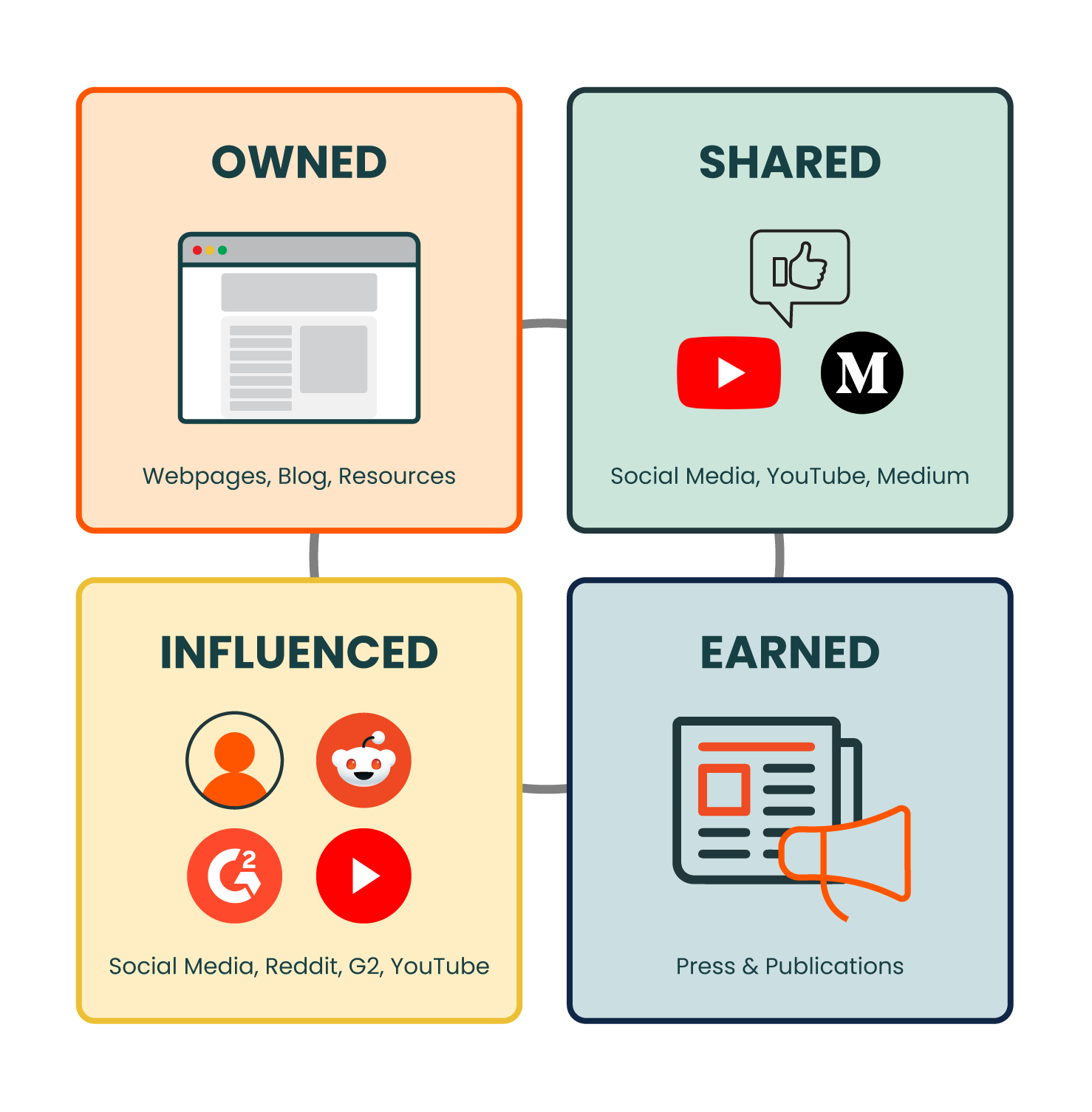
But public relations encompasses considerably more than media relations. It includes analyst relations, executive visibility, thought leadership, speaking programs, awards, corporate communications, crisis communications, and increasingly, influence over how AI systems represent your brand. We’ll cover each of these.
Public Relations Strategy
Good PR strategy doesn’t start with a press release. It starts with a narrative.
A strategic narrative is the unifying story a company tells about why it exists, what it’s changing, and where the market is headed. A tagline it isn’t. Nor a positioning statement, though those things should roll out of it. It’s the argument for the company’s relevance: short enough to fit in an elevator, deep enough to fill a keynote. Companies that win their category almost always have one, whether they can articulate it or not.
Before any PR strategy is worth writing down, the company needs to be honest about four things. Who are we actually talking to? What do they believe right now that we need to shift? What are we uniquely qualified to say? And how will we know it’s working? The companies that skip these questions end up with PR programs that chase coverage for the sake of it, mistaking activity for progress.
Once the narrative is clear, the strategy maps it onto specific audiences and channels. For a late-stage B2B SaaS company, that might mean a CFO-targeted byline program in finance trades, an analyst briefing cycle with Gartner and Forrester, a research program that generates original insights, and a podcast circuit for the CEO. For an early-stage AI startup, it might mean a tightly-scripted launch in TechCrunch, a drumbeat of product updates in vertical trades, and a founder presence on X and LinkedIn that feels human rather than performatively thought-leaderly.
The strategic output is a program, not a calendar. A PR modern strategy that can be summarised as “we’ll put out a press release every month” is not a strategy. It’s a to-do list.
Public Relations Tactics
Tactics are where strategy meets the reporter’s inbox. The core toolkit hasn’t changed radically in two decades, even if the delivery has. Press releases remain useful for news the market expects to see in a specific format, such as funding rounds and acquisitions. Media pitches, which are short personalized emails to specific journalists, remain the primary vehicle for earning coverage outside of announcement moments. Briefings, both on-the-record and under embargo, give reporters the context they need to write something substantive. Press kits (now mostly digital) house logos, product shots, executive bios, and the latest company facts.
Beyond earned media, modern PR tactics also include contributed articles (bylines the company writes and places in trade publications), speaking submissions, awards applications, podcast appearances, social commentary on current events, and increasingly, optimization for generative AI systems. That last one is newer, and it’s behind the increased demand for PR: when a buyer asks ChatGPT or Perplexity for the top vendors in a category, the answer is shaped by how frequently and credibly the brand appears in the sources those tools ingest. Earned media is part of that training data. PR is now in the AI visibility business.
The best tactical programs combine these across a 90-day rhythm. A quarter might include one major announcement, two or three contributed articles, two analyst briefings, three award submissions, a dozen proactive pitches tied to news hooks, and an executive visibility cadence that keeps spokespeople in the conversation week over week. Consistency win in PR, and most programs that fail, fail because they went quiet.
Types of Public Relations
PR is a big tent. What follows are the disciplines most B2B tech companies end up running simultaneously.

Media relations
is the bit everyone recognizes. It's the practice of building relationships with journalists and helping them do their job well enough that they want to include your company in their stories. The people who are actually good at this treat reporters as humans with deadlines to hit and their own challenges, not as distribution channels. It's less transactional than it looks, and it compounds: a reporter who trusts you at one outlet often moves to another and takes that trust with them.

Analyst relations
is media relations' more formal sibling. Firms like Gartner, Forrester, IDC, and 451 Research publish reports that B2B buyers actively read to narrow down shortlists. Getting into those reports, and being described accurately inside them, requires a dedicated briefing cycle, a steady flow of customer references and product updates, and a willingness to take feedback on positioning without becoming defensive. This discipline punches above its weight in enterprise deals.

Corporate communications
covers how a company talks about itself: funding, leadership changes, acquisitions, annual milestones, culture. Think of it as the voice of the organization at the corporate level, distinct from product or executive-level voices. Get it right and corporate comms reinforces your strategic narrative across every news moment. Get it wrong, and what you end up with is a series of press releases nobody remembers.

Product PR
is the discipline of launching and sustaining coverage around what the company actually builds. In B2B tech, this often means orchestrating a launch that lands simultaneously in a top-tier outlet (for credibility) and relevant vertical trades (for buyer reach), then keeping the coverage alive with follow-on angles like customer wins, benchmarks, and use-case stories.

Executive visibility
sometimes called thought leadership, is the practice of building the profiles of senior leaders so they become sources the press and market want to hear from. In early-stage companies, the founders are the brand, and their visibility directly drives pipeline, recruitment, and fundraising. In later-stage companies, the CEO, CFO, CTO, and CHRO each reach different audiences, and a mature program cultivates each deliberately. Bylines, podcasts, speaking engagements, and original research all feed this discipline.

Influencer and community relations
have become serious PR work in B2B tech. Developer-focused companies live and die by their standing in communities like Hacker News, Reddit, and specialist Slack groups. Creator partnerships, once the preserve of B2C, now drive real results for technical tools when done with the right voices.

Internal communications
matter more than most startups realize. Employees are your most credible brand ambassadors, and if they're confused about the narrative, the narrative isn't working. This discipline lives at the intersection of HR and PR, and it's where some of the most underrated reputation risk sits.
The single most important element of crisis readiness is speed of decision-making. The companies that come out of a crisis with their reputation intact are almost never the ones with the cleverest statement. They’re the ones who moved fast, said true things, and then held the line when the pressure came to walk it back. The companies that come out worst waited too long to respond, tried to blame someone else, and ended up letting the story write itself around them.
A crisis PR plan worth the name includes a pre-identified response team with decision authority, a clear chain for approving public statements, a rehearsed set of scenario responses, a list of the journalists and analysts who’ll call first, and a plan for communicating with employees, customers, and investors in parallel. If you don’t have this, and you’re a company of any meaningful scale, it’s the first thing to build before you need it.
Importance of Public Relations
Ask a CFO to justify the PR line, and a good answer hinges on four things PR does for the business that nothing else can do as well.
Awareness and discovery
Before someone buys from you, they need to know you exist. For B2B tech, where purchases are high-consideration and the buying committee averages ten or more people, awareness usually gets built across weeks or months of ambient exposure. Coverage in the publications your buyers read, mentions in the analyst reports they trust, appearances in the podcasts they commute to. Those are the drip, drip, drip of brand awareness and becoming a known quantity.
Credibility and trust
This is the quiet superpower of earned media. When a respected publication describes your company in its own words, that description lands with a force no amount of paid media can match. Buyers discount what companies say about themselves. They don’t discount, or discount far less, what third parties say. Analyst placement functions the same way in enterprise cycles. A Gartner Magic Quadrant mention can shorten sales cycles measurably and do reputation management work no owned channel ever could.
Category shaping
The best PR programs don’t just describe the company; they describe the market the company wants to compete in. When a vendor successfully defines the category, they often define the buying criteria too. Every subsequent RFP ends up asking the questions the category leader wanted asked. This is worth more than any individual piece of coverage and it’s almost entirely invisible on a dashboard.
Risk mitigation
The PR that never gets measured is the PR that prevented a small issue from becoming a large one. A thoughtful response to a critical article. A proactive conversation with a reporter before they filed. A quiet outreach to an analyst who had concerns. None of that shows up in coverage reports. It shows up as the crisis that never happened. Worth a lot, and impossible to point to in a QBR.
And now, the newer fifth mechanism:
AI visibility / discoverability
When a prospective buyer asks an AI assistant for recommendations, the answer is shaped by what the model has read. The model has read a lot of earned media. The brands that have consistently appeared in quality publications for years have a structural advantage in generative search that latecomers can’t easily buy. This is not the marketing trend of 2026; it’s a permanent change in how buyers research.
There’s a version of this section I could have made more cynical, and it’d go something like: PR is the discipline that makes every other marketing investment work harder. Paid media performs better when the brand is known. SEO ranks better when earned backlinks accumulate. Sales closes faster when prospects already recognise the logo. Recruiting attracts stronger candidates when the story is compelling. PR is the multiplier on everything else, and that’s true whether or not anyone in the finance department wants to admit it.
How Do You Measure Public Relations?
The honest answer is that PR measurement is harder than measurement in performance marketing and easier than measurement in brand.
The field has a shared framework for this, thanks to AMEC (the International Association for Measurement and Evaluation of Communication) and its Barcelona Principles, first published in 2010 and updated several times since. The principles themselves are intentionally simple. Measurement should focus on outcomes rather than outputs. It should be both qualitative and quantitative. It should reflect impact on organizational goals. Social media should be measured on the same terms as traditional media. And, the one that gets ignored most often, advertising value equivalency (AVE) is not a measure of value.
AVE is the practice of calculating what it would have “cost” to buy advertising space equivalent to your earned coverage. It became popular in the 2000s because it gave PR a number to show executives. It has also been roundly debunked, because ad value and editorial value are not the same currency. A quote in the Wall Street Journal does not have the same effect as a banner ad of the same size in the Wall Street Journal. Equating them flatters the number and misleads the decision.
What should you measure instead? That depends on what the PR program is trying to achieve, hence the strategy conversation upstream of the dashboard one. For most B2B tech programs, a useful dashboard includes share of voice against competitors in target publications, tier-weighted coverage volume (not all placements are equal), sentiment, message pull-through (did our key messages actually make it into the article, or just our company name), analyst positioning movement, speaking and award wins, executive visibility metrics, and a newer one: presence in AI-generated answers for category-relevant prompts.
Attributing business outcomes to PR is harder than attributing them to paid search. The buyer journey is too long and the touchpoints too numerous. But you can triangulate. Coverage bumps correlate with branded search volume and direct site traffic. Analyst mentions correlate with enterprise pipeline. Executive visibility correlates with inbound recruiting. You can also survey customers about where they first encountered you, and the answers are usually more revealing than the attribution models. PR builds the conditions under which other channels perform better. Measure it that way, not as a last-click channel, and you’ll stop fighting the wrong battle in board meetings.
Public Relations vs. Marketing
PR is marketing. It’s also, in important ways, not like the rest of marketing. Both can be true.
Inside most B2B tech companies, PR reports into marketing, often to the CMO. That makes sense. PR, content, demand generation, product marketing, and brand all ladder up to the same objective: growing the business. Treating them as separate fiefdoms produces the kind of siloed campaigns that underperform. The best programs integrate PR with content, search and paid, so the messages reinforce each other and the assets get maximum use. A customer study written as a press angle can become a gated asset, a byline, a paid social ad, and three months of organic posts. That’s good marketing.
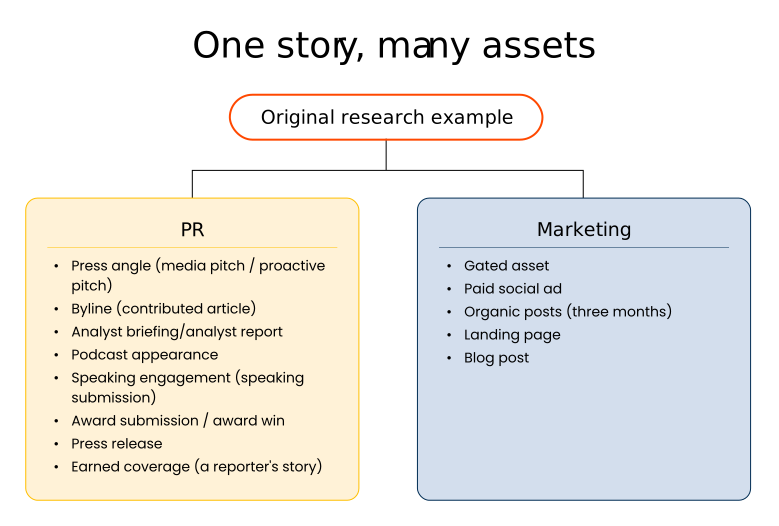
Where PR really differs is in the standard it has to meet. Marketing messages live on assets the company owns and controls. PR messages live on assets that belong to someone else: a reporter’s story, an analyst’s report, a podcast transcript. And those someones have their own standards for what gets included. A line of copy that’s fine for a landing page would get laughed out of a reporter’s email because it’s too promotional, too vague, or too obviously scripted. PR-ready messaging has to be more concrete, more defensible, and a whole lot more interesting than marketing-ready messaging. The discipline of writing for PR tends to sharpen the rest of the company’s language as a useful side effect.
The second real difference is time horizon. Performance marketing optimizes on weekly cycles. PR optimizes on quarters and years. Relationships with reporters take time to build. Narratives take time to land. Category perception shifts slowly. Leaders who try to run PR like a performance channel are almost always disappointed. PR works. They’re just measuring it on the wrong clock.
When to Hire a Public Relations Agency
Some companies do excellent PR in-house. Some companies work with agencies from day one and never bring it in-house. Most of the ones that end up with the best programs use a combination, which is worth saying out loud because the binary framing gets pushed too hard by both sides.
A public relations agency brings four things that are hard to build internally at early- and mid-stages. Relationships with reporters, analysts, and event programmers that took years to accumulate. Depth of domain expertise across the category, earned from working with multiple clients in adjacent spaces. A systematic approach to the rhythm of a PR program, refined across hundreds of iterations. And an outside perspective on the narrative that in-house teams, understandably close to the product, often can’t produce for themselves.
An in-house PR lead brings things that an agency cannot. Direct access to the CEO and the product roadmap. A stake in the company that no retainer can replicate. And, the kind of relationship with the business that makes them faster and better-informed on the things that matter.
The question isn’t usually “agency or in-house.” It’s “what’s the right mix at this stage.” For a seed-stage company with a founder who can pitch their own story, a fractional consultant paired with a specialist PR agency for startups may well beat hiring full-time. Growth-stage companies with a real news cadence tend to want a senior in-house comms lead plus an agency for execution. Public companies need both. And at every stage, the question of what specifically you need the PR function to achieve should come before the structural question of who delivers it.
The Bottom Line About Public Relations
Public relations in 2026 is a harder job than it was in 2016, and a more valuable one. The media has splintered across a thousand outlets and Substacks. The people your buyers listen to keep shifting. AI is rewriting the rules of discovery, and the brands that show up well in AI-generated answers are the ones with years of earned coverage sitting behind them. If you’re still treating PR as the soft bit of marketing, you’re losing ground to companies that treat it as core infrastructure. That gap is widening every quarter.
The good news is that the craft itself (telling sharp, useful stories to the people who most need to hear them) has never been more pivotal. One great story in the right outlet can change a company’s arc. A reporter who respects you will carry you through a decade of tough quarters and good ones. Get the category narrative right and you define the market everyone else has to pitch against.
If you’re a B2B tech or AI-native company marketer or even a founder weighing what to invest in this year, invest in PR, and invest in it properly. Not as a line item to tick off. Put narrative work in before pitching work. Hire people who know your category, not people who’ll charm their way through a pitch deck. And then commit to a long enough runway that the relationships, the category positioning, and the drumbeat of coverage have time to actually compound. The companies doing this well are already pulling ahead. Go be one of them.
Public Relations FAQs
What are the four types of public relations?
There are more than four, but the short answer most PR practitioners give is: media relations, corporate communications, crisis communications, and what’s variously called executive visibility or thought leadership. In B2B tech specifically, you’d add analyst relations as a non-negotiable fifth, because Gartner, Forrester, and IDC placements drive enterprise pipeline in ways no press coverage can match.
What is the difference between PR and marketing?
PR is a discipline inside marketing. The differences: PR earns its results on channels the company doesn’t own (a reporter’s article, an analyst’s report, a podcast), which means the messaging has to meet a higher standard because journalists and analysts have their own editorial bar. PR also works on a longer time horizon than performance marketing. Relationships compound. Narratives take quarters to land.
How much does a PR agency cost?
For B2B tech, monthly retainers at specialist agencies typically run from around $10,000 at the low end (a robust program for an early-stage startup) to $40,000+ for a full corporate and product PR program at a growth-stage company. Project-based work (a launch, a single campaign, crisis support) varies widely. Anything priced below $8,000/month is typically better suited to a freelancer.
How do you measure public relations?
Start by killing advertising value equivalency (AVE). It’s discredited and it misleads boards. Useful metrics for B2B tech include share of voice in target publications, tier-weighted coverage volume, key message pull-through, analyst positioning, speaking and award wins, and (newly) presence in AI-generated answers for category-relevant prompts. Correlate these with branded search volume, direct traffic, and inbound recruiting quality to triangulate business impact.
What does a PR agency actually do?
A good B2B tech PR agency builds and protects your reputation with the people who matter: journalists, analysts, prospective customers, investors, employees, and increasingly AI systems. Practically, that means shaping your strategic narrative, securing coverage in the publications your buyers read, getting you into analyst reports, building your executives’ profiles, running awards and speaking programs, and being the team you call when something goes wrong. The best agencies also integrate with your content and search programs so everything reinforces everything else.
When should a B2B tech startup hire a PR agency?
Most B2B tech startups benefit from PR help once they have a product in market, at least a handful of reference customers, and a funded growth plan. Typically, that’s around Series A, sometimes earlier if the founder is a strong spokesperson or the category itself is the story. Pre-product-market-fit startups usually get more from founder-led social and direct customer development than from a PR retainer.
What is crisis communications in PR?
Crisis communications is the PR discipline of managing urgent situations that threaten a company’s reputation, such as security breaches, executive misconduct, product outages, or regulatory actions. A competent crisis plan includes a pre-identified response team, a fast approval chain for public statements, a rehearsed set of scenario responses, and a parallel plan for communicating with employees, customers, and investors. Companies that come through crises well almost always move fast and tell the truth. The ones that don’t, usually equivocate until the story writes itself around them.
What is earned media?
Earned media is coverage a brand receives because a journalist, analyst, podcast host, or other third party with editorial independence chose to include it. It’s “earned” because no one paid for the placement and the brand didn’t publish it themselves. Earned media is more credible than owned or paid media for exactly that reason, and it’s also the primary source material LLMs draw on when they generate answers about a company or category. That makes earned media a double-duty asset in 2026.