If you’re a B2B tech or AI company trying to beat your competition in the war of awareness across traditional organic search and AI search, there’s a category of content you almost certainly need more of, and probably don’t have enough of yet…competitor comparison pages.
These aren’t the polished “why we’re better” pages your sales team wrote three years ago. We’re talking about strategically structured landing pages and content pieces that target the exact search queries your best-fit buyers are typing into Google, and increasingly, asking ChatGPT, Perplexity, and Gemini when they’re starting their research or actively evaluating solutions.
Queries like
- “[Your Product] vs [Competitor]”
- “best [category] solutions”
- “[Competitor] alternatives”
These are high-intent, valuable searches, and if your brand isn’t present when people are doing that research, you’re handing pipeline to the companies and competitors that are.
Competitor comparison pages also happen to be one of the highest-leverage content investments you can make for both SEO and GEO. They rank well, they get cited by AI engines, and they capture buyers at the exact moment they’re most ready to convert. If experiencing pushback from leadership that does not want to draw attention to competitors, a good compromise is to keep these pages out of the top level navigation (orphaned) as they will still achieve organic visibility and traffic for those who discover them in search engines.
In this post, we’ll cover what makes these pages so powerful, the three main formats [types] (starting simple, getting progressively more ambitious), and real-world examples you can model.
[Format 1] The Listicle: the easiest competitor comparison page to produce (and the most underused)
What is a listicle for SEO and GEO?
If you’re not familiar with the listicle format, the clue is in the name, it’s a piece of content structured as a list. Think “10 Best Financial Planning Software Solutions for 2026” or “Top 7 Project Management Tools for Remote Teams.” What is a listicle example in practice? Exactly those kinds of roundup articles that appear all over your search results whenever you’re researching a new category of software or product/solution.
For our purposes, knowing how to write a listicle for SEO means understanding that this format does a specific job: it targets buyers in the early stages of research, people who know they have a problem and are starting to map out the landscape of solutions, but aren’t yet deep enough into evaluation to be searching for specific feature comparisons or head-to-head reviews.
These buyers type queries like:
- “Best financial planning software”
- “Top corporate financial planning solutions”
- “Financial planning software for mid-market companies”
High volume. High informational intent. And almost certainly being surfaced in AI search results too.
Why are you letting Gartner get all the visibility?
Right now, when a buyer types one of those queries into Google, or asks ChatGPT to recommend tools in your category, the results are dominated by third-party review sites (G2, Capterra, Gartner Peer Insights, TrustRadius). These platforms have built enormous domain authority ranking for exactly these category-level keywords, and they monetise that visibility by charging vendors for placement. Your brand is just a row in their table.
But here’s what most B2B and AI companies haven’t figured out yet: you can create your own version of that page, on your own domain, and compete directly for the same organic visibility.
That’s precisely what Prophix did with their Top Corporate Financial Planning Software roundup — a page that essentially mirrors the same content as a Gartner Peer Insights listing, but lives on Prophix’s own site and feeds their own SEO and GEO performance.
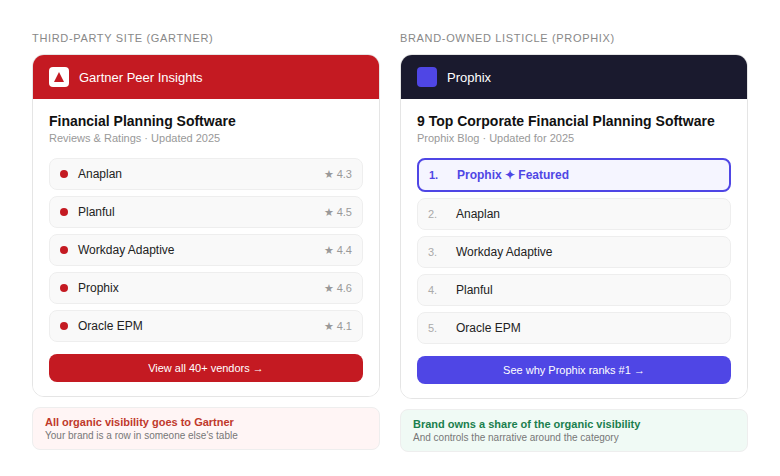
The comparison above illustrates the dynamic. Same category, same keywords, same buyer — but on the Prophix page, Prophix controls the narrative, anchors itself at the top of the list, and earns the citation whenever an AI engine pulls from that content.
What makes a listicle work for SEO and GEO?
The listicle is the simplest of all the competitor comparison page formats to produce. You’re not making strong claims about feature superiority or pulling performance data. You’re simply listing the key players in your space (including yourself) with neutral, factual descriptions of each. Copy for the other vendors can be pulled from their own websites or drafted with AI in minutes. Nothing controversial, nothing that requires original research.
This neutrality is actually a feature, not a limitation. AI engines like ChatGPT and Perplexity are specifically looking for pages that take an authoritative, category-level view of a market when they formulate recommendations. Based on GEO reporting data from our Scrunch dashboards, these listicle-style competitor comparison pages consistently outperform most other content types for brand mentions and citations in AI-generated responses around category queries — the “what are the best tools for X” questions that are now a massive part of how B2B buyers research. You don’t need to win the argument. You just need to be in the room.
[Format 2] The Competitor Comparison Page (Features and Benefits)
If the listicle is about establishing category presence, the competitor comparison landing page is about making the case for why your product or solution is better – without making any extreme claims. These pages target buyers who are past the “what options exist” stage and are now actively evaluating specific tools against each other. They’re typing queries like “[Your Company] vs [Competitor]” or “[Competitor] alternative” – and they are closer to making a decision. This is what makes key competitor comparison pages some of the highest-converting content on any B2B website. The traffic volume is lower than broad category keywords, but the intent is through the roof.
One page, one rival
The structure is straightforward: one dedicated competitor comparison page per competitor, each living at a clean URL like /yourbrandname-vs-competitorname. Don’t try to cram multiple rivals onto a single page — you’ll dilute the keyword targeting and water down the message. Each page should be tightly optimised for its specific “you vs. them” query, with the competitor name in the title tag, H1, URL, meta description, and naturally throughout the body copy.
Unlike the listicle, these pages require you to actually know your product and your competitors. You’ll need to make factual claims about features, pricing structures, and capabilities. That said, the goal isn’t to trash your competitor. It’s to present an honest, structured comparison that helps a prospective buyer understand the genuine differences. Overclaiming is the fastest way to lose credibility with both the reader and with AI engines that are increasingly good at detecting promotional puffery.
Competitor comparison landing pages are also exceptional paid search assets. When someone types a competitor’s brand name into Google, you can bid on that keyword and send them directly to your comparison page, and because the page is hyper-relevant to that query, your Quality Score stays high, which keeps your CPC low. You end up with a page that simultaneously earns free organic traffic and acts as a high-converting destination for paid clicks on competitor keywords.
What does a competitor comparison page look like?
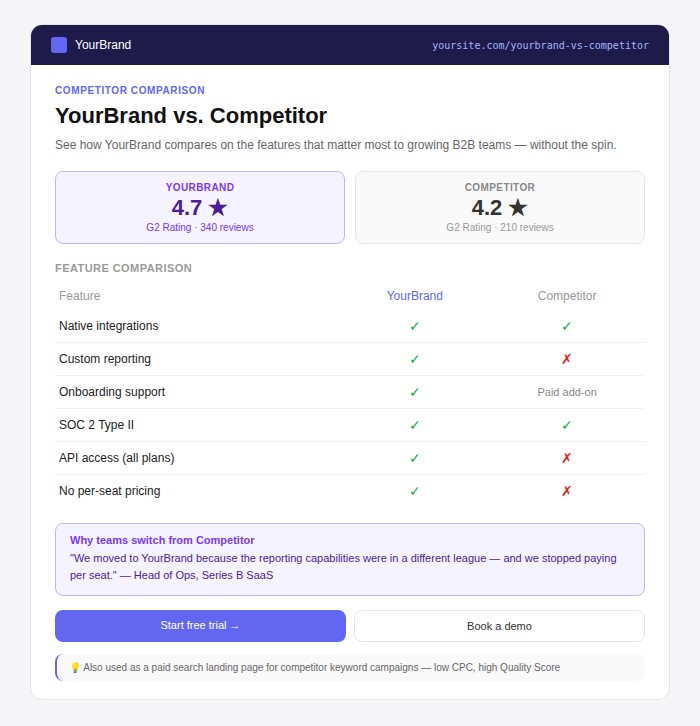
The anatomy of a good competitor page, as shown above, typically includes:
- A clear headline framing the comparison (“Your Brand or Product Name vs. Competitor Brand or Product Name”)
- Summary of each product’s G2 or Capterra rating for immediate third-party validation
- Clean feature comparison table
- Section pulling in real customer quotes about why they switched
- Clear CTA
- Video reviews or explainers (if possible)
To help search engines and AI models parse and cite the structured data correctly. Structured data is particularly valuable for comparison tables and can give you an edge in rich snippet rankings. This is one of the more technical but high-value steps — properly marked-up comparison data is exactly the kind of source that ChatGPT and Perplexity pull from when answering “how does X compare to Y” questions.
[Format 3] The Competitor Comparison Page (Technical/Performance)
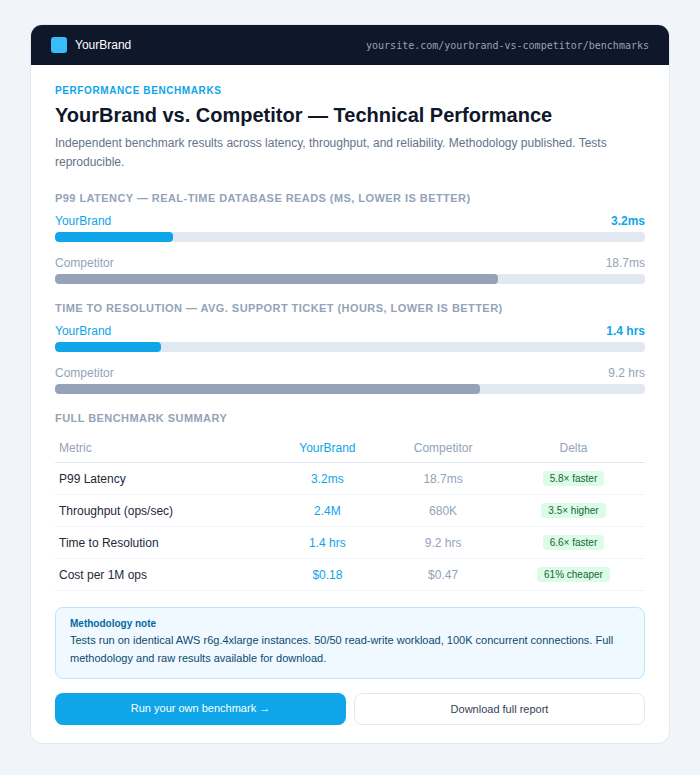
If the feature competitor comparison page is aimed at buyers who are evaluating, the technical performance page is aimed at buyers who are deciding. These are the engineers, architects, and technically-minded procurement leads who won’t sign off on a platform until they’ve seen the numbers. Reproducible, methodology-backed, head-to-head benchmark data.
This is why these are the hardest competitor comparison pages to produce. You can’t write them with boilerplate copy or AI-generated summaries. They require your engineering or product team to actually run controlled performance tests — your product against a named competitor’s, under identical conditions — and publish the results. For many B2B companies, that’s a significant ask. But for AI infrastructure companies, database platforms, developer tools, and any product where performance is a core buying criterion, it’s table stakes.
ScyllaDB’s ScyllaDB vs. DynamoDB page is a textbook example of this format done well. ScyllaDB leads with a hard cost claim: 50% of the cost of DynamoDB, guaranteed, and then supports it with latency data, architecture explanations, and a live pricing calculator. It’s a page built for an engineer who wants to justify a migration internally. Every element earns trust through specificity.
Why these pages dominate organic search and AI citations
Technical performance competitor comparison pages are purpose-built for a set of search queries that no other content format handles well. Queries like:
-
- “[Brand] performance benchmarks”
- “[Competitor] performance benchmarks”
- “[Brand] vs [Competitor] performance benchmarks”
-
- “[Brand] vs [Competitor] specific benchmark metric or question”
- “Which [Category of Product] performs best at xyz”
These are low-volume, extraordinarily high-intent queries. The person typing them is not browsing. They are in procurement. And because so few companies publish this kind of rigorous data, the pages that do tend to rank in top positions quickly, both in traditional search and as cited sources in AI-generated answers.
This also makes these key competitor comparison pages for branded performance searches. Terms like “[Brand] benchmarks” and “[Brand] performance” are increasingly being searched by buyers who’ve already heard of you and want validation. Owning those terms on your own domain, rather than leaving them to G2, Reddit threads, or a competitor’s blog, is a significant organic and GEO advantage.
Start Building Your Competitor Comparison Page Strategy
Most B2B and AI companies have none of these pages. A few have one or two hastily written “why us” pages that haven’t been touched since the website launched. The opportunity that creates, where well-structured, factual comparison content is exactly what generative engines are hungry for – is significant and still largely untapped.
The three formats above aren’t mutually exclusive, and you don’t need to build all of them at once. Start with a handful of competitor comparison landing pages targeting your highest-volume “vs” and “alternative” keywords, layer in a listicle or two to capture category-level visibility, and if performance is a genuine differentiator in your product, then invest in the benchmark page that will do the heaviest conversion lifting. Each page compounds. Every new competitor comparison page you publish is another entry point for buyers who are actively in-market, another citation opportunity for AI engines, and another keyword cluster you’re owning instead of ceding to G2, Capterra, or a rival’s marketing team.
If you want help building out a competitor comparison page strategy, from keyword research and content architecture through to technical SEO and GEO optimization, talk to the Firebrand team. We work with B2B tech and AI companies at every stage to build the kind of organic and AI search presence that actually drives brand growth.
About the Author

Alastair Nee is Senior Vice President of Digital Marketing at Firebrand, a B2B tech marketing agency based in the San Francisco Bay Area that helps companies grow through creative, data-driven marketing strategy. With a rare left-brain/right-brain approach, Alastair blends sharp analytics with standout creative instincts to build and scale high-performing growth marketing programs that elevate brand profiles and increases their pipeline using the channels and tactics that work best for B2B tech marketing today: GEO/SEO, AI-enhanced paid media, and advanced analytics.
At Firebrand, Alastair leads a team that partners with some of the most innovative names in tech - from AI/ML and data infrastructure to developer tools and B2B SaaS. Over his 17-year career in tech marketing, he has helped launch and grow dozens of companies, delivering award-winning campaigns recognized by The Communicator Awards and other industry benchmarks.
Alastair is a vocal advocate for modern growth marketing and emerging disciplines like AI-powered marketing technology, AI paid media optimization, and Generative Engine Optimization (GEO). His work lives at the intersection of storytelling and performance - where brand meets demand.
Follow Alastair on LinkedIn or explore his thinking on Firebrand’s blog.