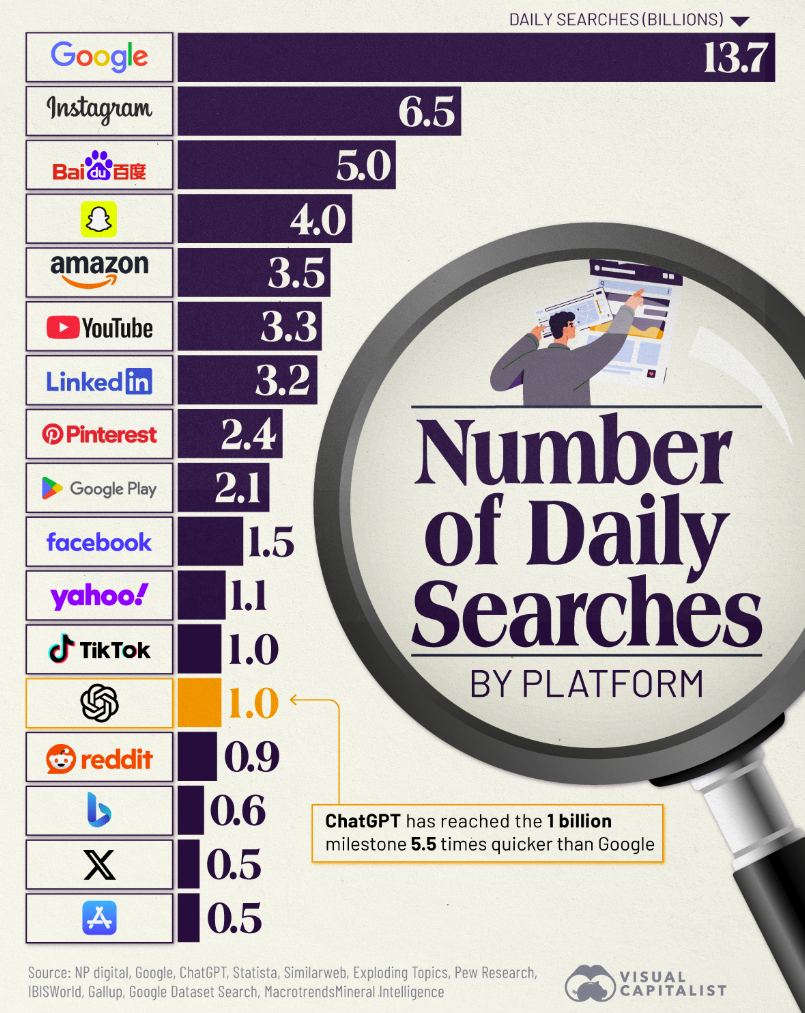
The organic search world is in the middle of a transformation that makes previous algorithm updates look like minor tweaks. AI search platforms like ChatGPT, Perplexity, and Claude are reshaping how people discover information, and their share of the search market continues to climb. ChatGPT is already handling nearly 1 in 10 of the search-related activities that Google processes daily (via SEOClarity), which is pretty remarkable for a product that’s barely three years old. That growth trajectory isn’t slowing down anytime soon.
But here’s the reality check before anyone starts writing Google’s obituary: Google averages 13.7 billion searches per day (according to this report), more than double the second-place platform, Instagram (6.5 billion). Even as AI search gains momentum, Google is still processing roughly 210 times more than ChatGPT’s search-like queries (via Search Engine Land). Traditional search isn’t dead. It’s not even close.
This is exactly why a dual optimization strategy matters more than ever, especially in the tech B2B space where buyers are increasingly tech-savvy and comfortable bouncing between traditional search and AI platforms during their research journey. You can’t just optimize for humans and Google’s crawlers anymore (that’s your classic SEO playbook). Now you also need to optimize for how large language models consume, understand, and surface your content (hello, Generative Engine Optimization). The brands that figure out how to show up effectively in both traditional search results and AI-generated answers are the ones that will influence potential buyers at every stage of their journey.
So what’s actually coming in 2026? Let’s break down the GEO and SEO predictions 2026 that matter most for B2B marketers trying to stay ahead of the curve.
1. Human-Created Content Will Outperform AI-Generated (For Both SEO Rankings and AI Visibility)
Here’s something that should excite every human writer: your actual expertise, personality, and original thinking are becoming more valuable, not less. Google’s stance on AI content has evolved, but the bottom line remains clear. According to Google’s guidelines, automatically generated content falls under spam if it’s intended to manipulate search rankings rather than help users. While AI content can technically rank if it meets quality standards, Google’s quality raters are now explicitly trained to identify content that’s entirely AI-generated with little human input and rate it as the lowest quality.
The reason is simple. Human creators bring conversational flair, humor, originality, and genuine subject matter expertise that AI struggles to replicate. That authenticity resonates with both human readers and the algorithms designed to serve them. When search platforms and LLMs are looking for content to surface or cite, they’re prioritizing sources that demonstrate real expertise and originality, not repackaged generic information. As the dead internet theory becomes more reality and bot-generated content continues flooding the web, platforms will increasingly tweak their algorithms to prefer genuinely human-made content, because keeping actual humans engaged has always been their bottom line.
2. Off-Page Authority and Pattern Signals Will Be More Important Than Ever
The days of ranking purely on the strength of your own website are long gone. Both traditional search crawlers and LLMs are increasingly looking beyond your domain to verify that you’re actually worth citing. They want to see patterns across other trusted sources that validate what your business is good at and who you serve. Think of it as digital word-of-mouth on steroids. Backlinks remain a primary signal Google uses to assess authority and trustworthiness, and off-page signals, social mentions, and reviews solidify trust in Google’s eyes.
Other off-page tactics will help propel your presence, including YouTube SEO (video content continues to dominate citations), LinkedIn presence (especially for B2B credibility), content syndication that expands your footprint, guest blogging on authoritative sites, and podcast appearances that showcase your expertise. Each of these off-page touchpoints creates another data point for algorithms to confirm that real humans trust your brand. In 2026, the brands winning in organic search won’t just have great content on their own site. They’ll be everywhere their audience is, earning mentions, citations, and backlinks that prove they’re legitimate players worth surfacing in both traditional search results and AI-generated answers.
3. Generative Engine Optimization (GEO) Is No Longer a Nice-to-Have, It’s a Must-Have
Your boss is going to ask this question in Q1 2026: “So, what’s our strategy for AI search visibility?” This isn’t about them being trendy or chasing the shiny new thing. It’s about them understanding that GEO has crossed the threshold from experimental tactic to critical business function. AI visibility will become a massive KPI that leadership expects you to report on, right alongside organic traffic and conversion rates. The data backs this up in a big way. Website traffic from AI search platforms may surpass traditional search traffic by 2028 (via SEMrush), and that timeline could accelerate if Google’s AI Mode becomes the default search experience.
Zero-click behavior is already the reality for roughly 60% of searches on traditional search engines (according to SEMrush), meaning if you’re not serving up the best, most authoritative information in AI-generated answers, you’re losing out on vital brand awareness impressions. When users never click through to your site but still form opinions about your brand based on whether AI platforms cite you as an authority, visibility in those AI responses becomes everything.
The Evolution of GEO Measurement
The GEO measurement infrastructure is evolving fast, and there’s a legitimate gold rush happening right now around GEO reporting tools. Companies like Scrunch, Gumshoe, Ahrefs, Keyword.com, and SEMrush are racing to perfect AI visibility tracking. Speaking of SEMrush, Adobe just acquired them for $1.9 billion specifically to strengthen its capabilities in both SEO and GEO. That’s not a small bet. Adobe is targeting optimization for generative engines as a new frontier, which tells you everything you need to know about where enterprise marketing is headed.
The smart move isn’t to wait until GEO measurement is “perfect” before you start investing. It’s to get in now, establish your baselines, and evolve your strategy as the platforms release more data (likely tied to future monetization through ads). The companies that start optimizing for AI visibility today will have years of learning and iteration under their belts by the time everyone else realizes they got caught flat-footed.
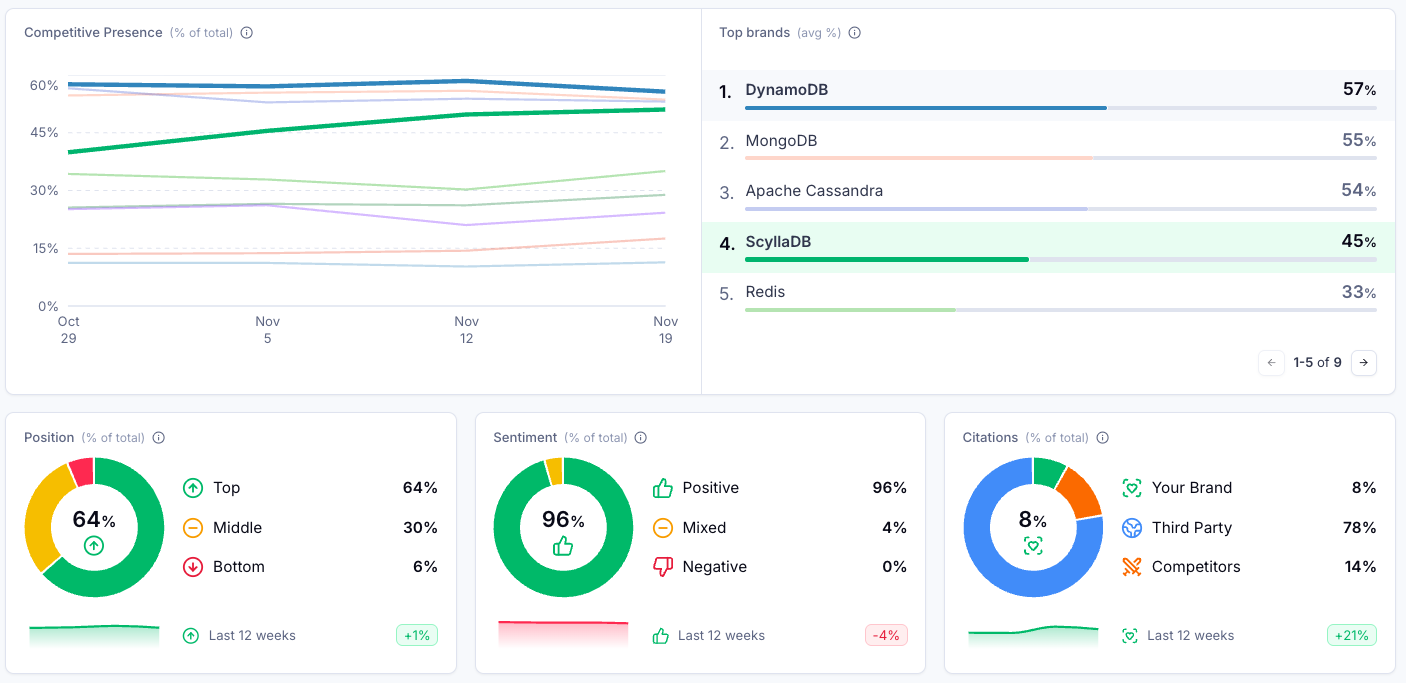
Scrunch AI Visibility
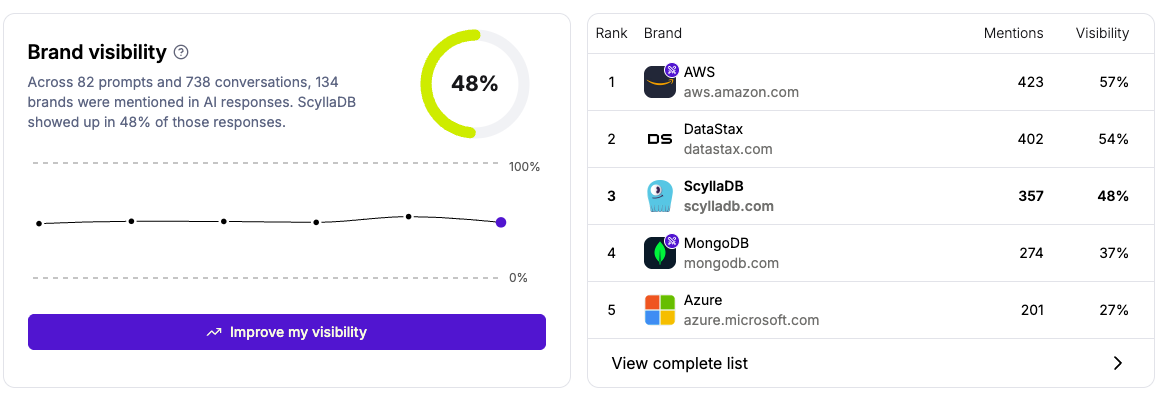
Gumshoe AI Visibility
4. The Websites That Are Well-Oiled Machines Will Generate More Pipeline
Let’s talk about the new economics of organic traffic. With roughly 60% of searches yielding zero clicks as mentioned before, every visitor who actually makes it to your website in 2026 is precious <insert Gollum voice: “My Preciousss”>. The clicks are harder to earn, which makes each one exponentially more valuable. This means your website performance, messaging, and user experience need to be firing on all cylinders. Technical performance isn’t just an IT problem, it’s a revenue problem. Improving loading speed by just 0.1 seconds can boost conversion rates. Mobile experience is critical too, since mobile users abandon sites that take too long to load.
But speed alone won’t save you if your messaging is off or your user experience is clunky. In 2026, winning websites will nail the trifecta: technical excellence (fast load times, mobile optimization, zero layout shifts), messaging that seamlessly blends marketing copy with SEO keywords in a way that actually resonates with humans, and UI/UX with thoughtful conversion rate optimization that guides B2B tech buyers smoothly toward becoming leads. That means building out real differentiators, showcasing your brand personality, and creating lead magnets worth trading an email address for.
Bonus tip: content freshness matters more than ever for both rankings and citations. ChatGPT shows the strongest recency bias, with 76.4% of most-cited pages updated in the last 30 days and nearly 90% of AI bot hits occurred on content from the last three years. Regularly publishing and updating thought leadership content not only demonstrates expertise but also plays directly into the recency algorithms that both traditional search engines and LLMs favor when deciding what to surface and cite.
5.Building Authority with Search Engines and LLMs by Showcasing Author Expertise Will Become Pivotal
Author provenance is about to become the secret weapon that separates the winners from the unknowns in 2026. Think of it as SME-led content marketing, where both traditional search engines and LLMs will increasingly prioritize understanding not just what content says, but who’s saying it and why they’re qualified. Google strongly encourages adding accurate authorship information, such as bylines, to content where readers might expect it, and E-E-A-T (Experience, Expertise, Authoritativeness, and Trustworthiness) operates at three distinct levels: content, author, and brand.
We predict that in 2026, the author level will become the most scrutinized signal for both rankings and AI citations as algorithms get better at distinguishing real expertise from generic content. To capitalize on this:
- Ensure every author bio is rich with relevant credentials and strategically loaded with keywords that signal topical authority.
- Build dedicated author pages that showcase expertise comprehensively, including professional credentials, social profiles, certifications, and a compelling explanation of why this person is uniquely qualified to write on these topics. Author pages should include professional name and title, a high-quality headshot, active social profiles, topical credentials, and a persuasive explanation of qualification searchengineland.
- Amplify these experts across social media, podcasts, and webinars to build their digital footprint. This plays directly into the pattern recognition that both search algorithms and AI systems rely on.
6. Real Human Community Sentiment Will Generate Crawler and LLM Sentiment
AI and traditional crawlers don’t have opinions. They serve links and answers based on what relevant communities of real people are saying. In 2026, you’d better be figuring out how to shape public opinion through a combination of actually improving your product, crafting educational content, and ensuring community-led sites are telling a good story about you.
Reddit and Wikipedia dominate the citation landscape (despite recent declines) and these platforms work because they’re community-moderated, which signals authentic human experience to algorithms. Despite some recent fluctuations, positive Reddit discussions about a brand often translate into positive mentions by AI in conversational answers, making professional Reddit engagement programs a genuine necessity rather than a nice-to-have experiment.

Bonus tip: A newer tactic gaining traction is publishing listicle pages that attach your brand to key concepts (example:“Best FP&A Platforms for 2026”) where you list your solution alongside competitors. This sets you up to be the citation when users are comparing options. Similarly, competitor comparison pages that detail actual feature differences are tried-and-true for both SEO and GEO.
7. New Types of Technical Optimizations and Markup Will Make an Impact
The technical foundation of organic visibility is evolving fast, and 2026 will be the year when new markup standards and AI-specific optimizations move from experimental to essential. We already know that Schema.org markup is critical for rich results in traditional search and Google AI Overviews, but in 2026, structured data will become even more important for AI visibility. Google has confirmed that Gemini, which powers AI Overviews, leverages structured data to understand content more effectively, and schema markup helps LLMs recognize your content, increasing the likelihood of you being cited. Beyond traditional schema, new tactics are emerging. The llms.txt file is gaining traction as a way to guide AI systems to your most valuable content. Major AI companies like OpenAI, Anthropic, and Perplexity have begun consulting llms.txt files when crawling websites.
Companies like Scrunch are offering what they call an “AI-friendly” version of your website through their Agent Experience Platform (AXP), which auto-detects when AI traffic is visiting your site and serves up an optimized version for bot traffic consumption Similarly, Everything Machines calls their solution an “AI-Ready EverythingCache,” describing it as a brand-specific data store, meticulously curated for consumption by Large Language Models. The beauty of these approaches is that they let you separate your marketing message for humans from your AI-optimized content. You can publish quick-fire explanatory content structured perfectly for AI without worrying about it being emotional or sales-focused enough for human visitors. This is the future: dual-track content strategies where you demonstrate deep authority to LLMs through comprehensive, structured information while maintaining compelling, conversion-focused experiences for human buyers.
8. PR Is Having a Renaissance (And It’s More Important Than Ever for SEO and GEO)
If you thought PR was just about brand awareness and media buzz, 2026 is going to change your mind. PR has become fundamental to both SEO and GEO because nothing signals authority for a company more powerfully than being mentioned or featured in credible publications. Digital PR links are some of the most powerful backlinks you’ll come across, providing both brand recognition and a powerful signal of authority that achieve higher SERP rankings, more traffic, and improved domain authority.
This connects everything we’ve discussed. PR feeds into E-E-A-T signals, drives the positive sentiment we covered earlier, and builds the off-page pattern recognition that both crawlers and LLMs use to validate authority. The brands dominating organic visibility in 2026 will be the ones investing in strategic PR that positions their executives as industry voices, secures coverage in publications that LLMs trust, and creates a distributed network of high-authority mentions across the web. When AI systems and search engines see consistent patterns of credible publications referencing your brand, they confidently surface you as the authoritative answer.
Stop Predicting, Start Preparing for the Future of SEO and GEO
Look, SEO predictions for 2026 and GEO predictions for 2026 aren’t about having a crystal ball. They’re about recognizing the patterns already forming and positioning yourself ahead of the curve. The predictions we’ve outlined here aren’t wild speculation, they’re strategic responses to shifts already underway in how people discover and evaluate B2B tech companies.
Human-created content, off-page authority, AI visibility, website performance, author provenance, community sentiment, technical optimizations, and PR aren’t separate tactics. They’re interconnected pieces of a modern multiplier marketing strategy that works across both traditional search engines and AI platforms. The companies that win in 2026 won’t be the ones still arguing about whether GEO matters or debating if SEO is dead. They’ll be the ones who committed to a dual-optimization strategy that influences buyers wherever they’re searching.
If you’re ready to stop reacting and start leading, we’d love to help. Firebrand’s GEO services, SEO services, and content strategy expertise are purpose-built for B2B tech companies navigating this exact transformation. We’ve helped dozens of innovative brands build organic visibility that drives real pipeline growth, and we know how to make you show up as the authoritative answer in both traditional search results and AI-generated responses.
Let’s talk about building your 2026 strategy before your competitors do.
About the Author

Alastair Nee is Senior Vice President of Digital Marketing at Firebrand, a B2B tech marketing agency based in the San Francisco Bay Area that helps companies grow through creative, data-driven marketing strategy. With a rare left-brain/right-brain approach, Alastair blends sharp analytics with standout creative instincts to build and scale high-performing growth marketing programs that elevate brand profiles and increases their pipeline using the channels and tactics that work best for B2B tech marketing today: GEO/SEO, AI-enhanced paid media, and advanced analytics.
At Firebrand, Alastair leads a team that partners with some of the most innovative names in tech - from AI/ML and data infrastructure to developer tools and B2B SaaS. Over his 17-year career in tech marketing, he has helped launch and grow dozens of companies, delivering award-winning campaigns recognized by The Communicator Awards and other industry benchmarks.
Alastair is a vocal advocate for modern growth marketing and emerging disciplines like AI-powered marketing technology, AI paid media optimization, and Generative Engine Optimization (GEO). His work lives at the intersection of storytelling and performance - where brand meets demand.
Follow Alastair on LinkedIn or explore his thinking on Firebrand’s blog.